
Komodo Manta Season: When You’ll Actually See Mantas (Honest Month Guide)

Sekar Prameswari
May 12, 2026
14 min read
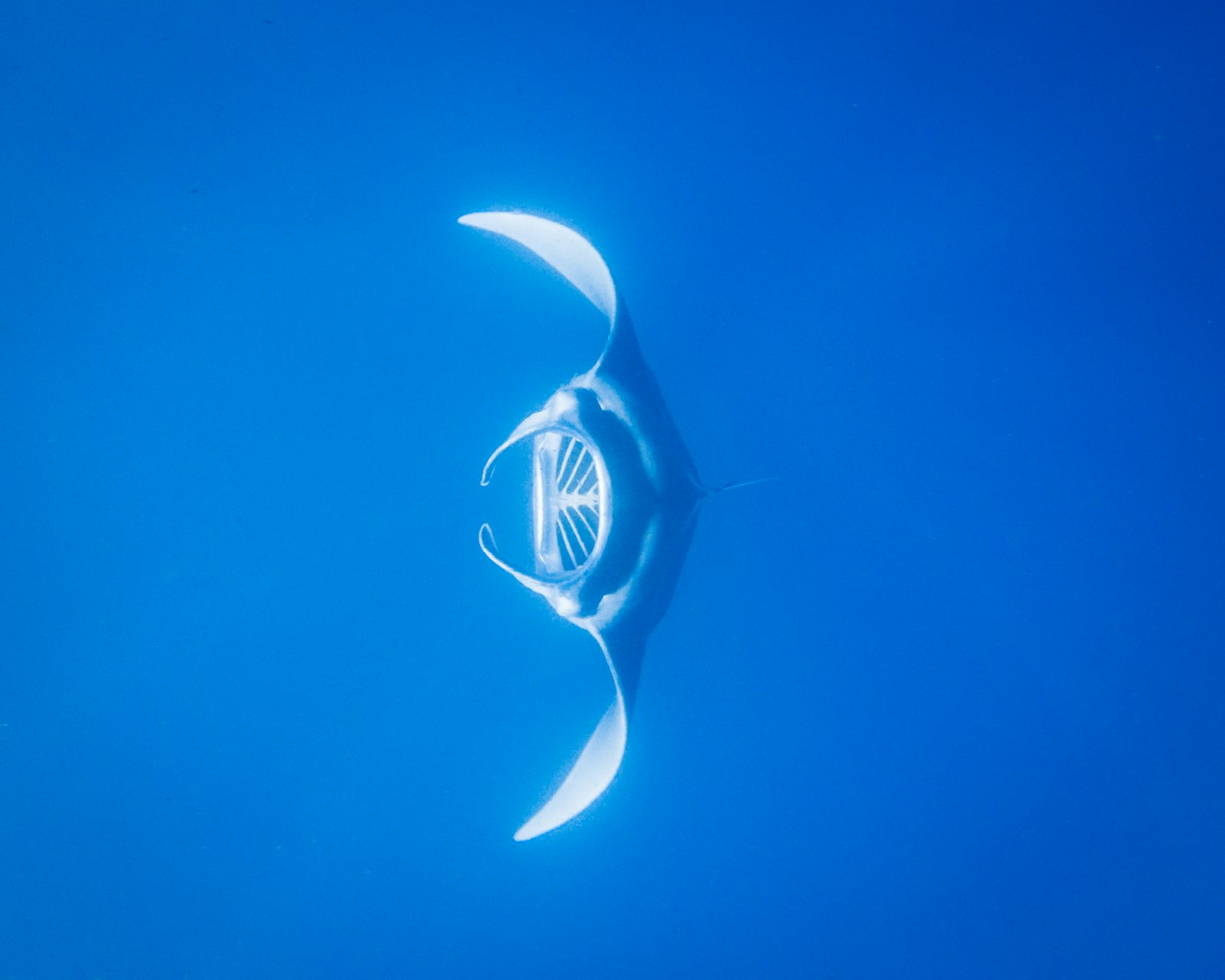
Komodo manta season is not a single window on the calendar — reef mantas (Mobula alfredi) are present in Komodo National Park year-round, using cleaning stations at central and southern sites across every month. What the calendar actually controls is numbers: bigger aggregations concentrate from roughly September through May, with the strongest gatherings in December through February or March when plankton blooms push into the park from both the Flores Sea and the Indian Ocean side. If you plan a trip around that broad arc, you are inside the manta window. The honest caveat is that higher manta density comes with lower water visibility — and I will explain that trade-off in plain terms below.
Why Mantas Are Here at All: The Biology Behind the Season
Komodo sits astride the Indonesian Throughflow, the current that moves Pacific water into the Indian Ocean through a narrow gauntlet of straits. Tidal exchange through Linta Strait and Sape Strait drives nutrient upwelling, and when that upwelling intensifies during the northwest monsoon (roughly November to March), phytoplankton blooms follow. Zooplankton feed on phytoplankton. Mantas filter zooplankton. The chain is direct.
Reef mantas in Komodo use two types of stations: cleaning stations, where small wrasse and cleaner fish remove parasites from the manta’s skin and gills, and feeding aggregations, where they somersault barrel-roll through dense plankton patches near the surface or mid-water. Both happen year-round, but feeding aggregations peak when the bloom is thickest — which is why December through February consistently produces the longest sighting sessions and the most mantas in a single dive.
One note on conflicting calendars: a minority of operators cite April through November as their preferred manta window. That framing is not wrong — it reflects conditions at specific northern sites where dry-season clarity makes encounters more photogenic. The majority of field reports and the scientific framing used by organisations like the Manta Trust align with September to May as the period of highest raw numbers, with December through February or March as the apex. I present the majority view here while acknowledging both exist.
The Two Manta Sites You Need to Know
All discussion of Komodo manta season collapses to two sites. They operate on different schedules, at different price points, and require different experience levels.
Karang Makassar (Manta Point) — Central Komodo, Year-Round
Karang Makassar is a shallow, roughly three-kilometre drift plateau in the central park, running at 8–18 metres with the productive zone between 10 and 15 metres. Current is gentle to moderate and varies with the tide. Every level of diver can do it. Snorkelers join the same boat. This is the site that makes Komodo famous for mantas because access is consistent across every month — day trips from Labuan Bajo reach it in about one to one-and-a-half hours by speedboat.
The cleaning stations here are well established. Multiple bommies each host a queue of mantas on a good day. In peak plankton season (December to February) you may count a dozen or more individuals on a single dive. In the quieter dry-season months of July and August, a single manta or a pair is more typical. Sightings still happen — just lower probability and shorter average station time.
Mawan, a site sometimes called “mini Manta Point” nearby, operates on the same seasonal rhythm and is worth factoring into itinerary planning, though it is less consistently documented than Karang Makassar.
Manta Alley — South Komodo, October to April Window
Manta Alley sits at the exposed southern tip of Komodo Island, facing the Indian Ocean. The cleaning and feeding stations here sit at 10–25 metres on bommies, with a shallow bay component at 5–10 metres. The difference from Karang Makassar is environmental: Manta Alley receives direct Indian Ocean swell and the full force of the Southeast monsoon from May through September. During those months the site is rough, often murky, and sometimes undiveable. The productive window is October or November through March or April.
When it is diveable, Manta Alley delivers a qualitatively different experience. The water is cooler (typically 20–25°C, with thermoclines common), visibility is often 10–20 metres though it can reach 30 metres in January and February, and the nutrient load that depresses visibility is the same nutrient load that attracts the highest manta densities in the park. Plan a 5mm wetsuit minimum; a 7mm or a 5mm with a hood is more comfortable. AOW certification and comfort with negative entries is the standard expectation at most operators.
Manta Alley is not reachable by day trip from Labuan Bajo — the transit time and conditions require an overnight liveaboard. South Komodo liveaboard routes of five days or more typically include Manta Alley along with Cannibal Rock, Yellow Wall of Texas, and the Horseshoe Bay complex on Rinca’s south coast. If Manta Alley is a priority, this is the trip to book.
Month-by-Month: What to Realistically Expect
The table below is a planning guide, not a sighting guarantee. Marine life does not observe calendars. A single dive on any of these months might produce nothing; another might produce something extraordinary. These are probability and access windows based on accumulated field knowledge and seasonal patterns.
| Month | Karang Makassar | Manta Alley | Water Temp (south) | Visibility (central) |
|---|---|---|---|---|
| January | High probability, large groups | Open, high density | 20–24°C | 10–20 m (plankton season) |
| February | High probability, large groups | Open, peak density | 20–24°C | 10–20 m |
| March | Good–high | Open, tapering late month | 21–25°C | 12–22 m |
| April | Good | Marginal to closed (conditions) | 22–26°C | 15–25 m improving |
| May | Moderate–good | Generally closed (SE monsoon building) | 23–27°C | 18–28 m |
| June | Moderate | Closed / rough | 24–28°C | 20–30 m |
| July | Lower, singles or pairs | Closed / rough | 24–29°C (north warmer) | 22–35 m (peak clarity) |
| August | Lower, singles or pairs | Closed / rough | 24–29°C | 22–35 m |
| September | Improving | Closed or just opening late month | 23–27°C | 18–28 m |
| October | Good | Opening, early aggregations | 21–25°C | 15–25 m |
| November | Good–high | Open, building | 20–24°C | 12–20 m |
| December | High probability, larger groups | Open, high density | 20–24°C | 10–20 m |
One trade-off worth stating plainly: the months with the highest manta density are the same months where visibility at central sites can drop to 10–15 metres. That is not a bad dive — manta encounters in green water with good ambient light are often closer and longer than encounters in clear water where the mantas are less anchored to food. But if wide-angle photography with 20-metre visibility is the goal, that combination is easier to find in October, early November, or the shoulder of March.
The Plankton Season Visibility Trade-Off (Explained Honestly)
Plankton blooms reduce water clarity. That is physics, not a flaw in the destination. When nutrient-rich upwelling brings cold water to the surface, phytoplankton multiply rapidly and the water turns green or milky. Visibility at Karang Makassar in January can be as low as 8–10 metres on heavy-bloom days. The same bloom brings the mantas. Trying to find both peak manta density and 30-metre visibility simultaneously is chasing a combination that rarely exists in the same week at the same site.
The practical answer: if you want the highest chance of a manta encounter and can accept 10–15 metre vis, book December to February. If you want clear water with still-reasonable manta probability, book October or late March. If you want 25–35 metre visibility and are happy to treat any manta as a bonus rather than the headline, July and August offer the clearest conditions — with the understanding that north Komodo in July is peak season overall and liveaboards book six to twelve months in advance.
Ready to start planning? Use our enquiry form or reach the team on WhatsApp — we will match the right trip timing to what matters most to you.
Reaching the Sites: Day Trips vs Liveaboards
The site you want dictates the trip type.
Karang Makassar (Manta Point) sits in the central park and is a standard inclusion on most Komodo diving day trips from Labuan Bajo harbor. A typical three-dive day trip — covering Manta Point plus one or two additional central sites — runs roughly IDR 2.5 million to 3.6 million per person before park fees (approximately USD 155–225 at current rates), with park entry and diver surcharge adding around IDR 300,000–400,000 per diver per day on top. The day trip departs around 07:30 and returns by 17:00.
Manta Alley requires a liveaboard. A five-to-six-day south Komodo liveaboard that includes Manta Alley, Cannibal Rock, and Horseshoe Bay typically starts from roughly USD 1,000 per person at budget end, with mid-range and luxury options ranging to USD 3,000 or more for the same duration. The site is physically about four to five hours’ transit from Labuan Bajo, making it impractical as a day-trip destination. Most south Komodo routes run October through April, which aligns with the Manta Alley access window. Beyond the mantas, the south Komodo package includes Cannibal Rock — widely cited as a world top-ten macro site — and Yellow Wall of Texas, two dives worth making the journey for independently of manta probability.
The Manta Code of Conduct
Indonesia declared its entire Exclusive Economic Zone a manta ray sanctuary in 2014 — the largest manta sanctuary in the world. Komodo National Park, as a UNESCO World Heritage Site, carries additional overlay protections. These are not aspirational guidelines; they are the legal framework under which these dives happen.
On any dive where a manta encounter is possible, the following behaviour applies without exception:
- Maintain at least 3 metres distance from any manta at all times.
- Approach from the side or slightly below — never from directly above or head-on, which triggers an avoidance response and ends the encounter.
- Do not chase, block, or cut off a manta’s path. If a manta changes direction away from you, let it go.
- Stay off the cleaning bommies. Divers hovering directly above a cleaning station suppress cleaning behaviour and cause mantas to leave. Position yourself low on the reef, 3–5 metres away, and wait.
- No flash photography at close range. Strobes at close distance startle mantas and have been associated with altered cleaning behaviour at busy stations.
- No touching, ever. Removing the mucus coating from a manta’s skin compromises its immune protection. Gloves are banned at most Komodo operators for this reason.
- Reef hooks only on bare substrate when permitted by your operator — never on live coral, and never to anchor yourself above a cleaning station.
The cleaning station interactions at Karang Makassar and Manta Alley persist because the sites have been dived responsibly for decades. That is worth protecting. A briefed dive guide will repeat all of this before you enter the water; if yours does not, ask.
Experience Level and Practical Preparation
Karang Makassar is appropriate for all certification levels, including Open Water divers with minimal logged dives. Current is manageable, depth is shallow, and the site is specifically selected by operators for mixed-ability groups. Snorkelers join the same dive platform on most day trips.
Manta Alley asks more. The standard expectation at most operators is Advanced Open Water certification with comfort in moderate to strong surge and current, plus the ability to execute a negative entry — going directly to depth on the descent line without lingering near the surface. The Indian Ocean exposure at the south tip of Komodo Island means conditions change faster than at central sites, and a dive guide’s call to abort is not negotiable. Cold-water readiness matters: a 5mm full suit is the minimum; a 7mm with a hood is preferable in December through February.
For both sites, a surface marker buoy (SMB) is non-negotiable in Komodo. Personal dive computers are expected. The nearest hyperbaric facility is at Siloam Hospital in Labuan Bajo — operators report it as the primary DCS resource for the park, with evacuation from most sites taking one to three hours.
Booking Logistics: What to Plan Around
July and August are peak tourist months across all of Komodo. The park enforces a cap of approximately 1,000 visitors per day across the whole park (all activities combined), managed through the SiORA app allocation system. Liveaboard slots for peak-season July and August departures frequently sell out six to twelve months in advance. If manta sightings are your specific goal and July–August your only available window, you are better served by the shoulder months (October–November or late March–April), which offer shorter booking lead times, lower prices, and better manta probability anyway.
Day-trip park fees are typically quoted separately from the trip price. Budget IDR 300,000–400,000 (approximately USD 18–27) per diver per day in fees. Some operators include fees in a quoted all-in price; others itemise them. Ask before you book.
Flights to Labuan Bajo connect via Bali (roughly one to one-and-a-quarter hours) or Jakarta (around two and a half hours). International visitors arrive via those connections; there is no direct international routing into Labuan Bajo at this time.
Want help matching the right trip format and timing to your specific goal? Our enquiry form is the fastest way to start — send us your available dates, certification level, and whether Manta Alley or Karang Makassar is the priority, and we’ll come back with honest options and current availability from our operator partners. No one can pay us to change what we publish; if you proceed with an operator through our free help, they may pay us a referral fee at no extra cost to you.
Frequently Asked Questions
When is the best time to see mantas in Komodo?
The highest probability window for large manta aggregations is December through February, when plankton blooms draw the greatest numbers to cleaning and feeding stations at both Karang Makassar and Manta Alley. A broader productive window runs September through May. Mantas are present year-round, so no month is without a realistic chance — but mid-December to late February is when you have the most going for you numerically. The trade-off is lower visibility (typically 10–20 metres) compared to the dry season’s 25–35 metres.
Can I see mantas on a day trip from Labuan Bajo?
Yes — Karang Makassar (Manta Point) is a standard day-trip destination and the most consistently visited manta site in the park. A three-dive day trip from Labuan Bajo typically includes it, with a transit time of roughly one to one-and-a-half hours by speedboat. Manta Alley, in south Komodo, is not accessible on a day trip due to distance and conditions; it requires an overnight liveaboard.
Is Manta Alley diveable in July and August?
Generally not. The Southeast monsoon brings swell and rough conditions to the exposed south tip of Komodo Island from roughly May through September, and Manta Alley faces directly into that weather. Most liveaboard operators remove south Komodo stops from July–August itineraries for this reason. The site’s productive window is October or November through March or April. If south Komodo diving is a priority, plan accordingly.
Are manta ray sightings guaranteed in Komodo?
No. No legitimate operator guarantees any specific marine life sighting, and anyone who does is promising something beyond their control. Mantas are wild animals with their own schedules. High-probability months and sites improve your odds significantly, but a zero-manta dive is always possible, just as an extraordinary encounter on a “quiet” month is also possible. This site will never describe a manta encounter as something you can count on — only as something worth planning for thoughtfully.
Do I need special certification to dive with mantas in Komodo?
For Karang Makassar, no — it is suitable for Open Water divers and even snorkelers. For Manta Alley in south Komodo, Advanced Open Water is the standard expectation given the surge, current, and negative-entry requirements. If you are specifically targeting Manta Alley, completing your Advanced certification before the trip is worth doing. Several Komodo liveaboards offer AOW courses on board during the trip, which can be a practical way to combine qualification and diving if your schedule allows.