Komodo Liveaboard Diving: Routes, Boats & Per-Cabin Prices from 4 to 9 Days

Ingrid Mathiesen
December 10, 2025
19 min read
How our trips work: Labuan Bajo Diving is the dive-specialist team of our operating partner Komodo Luxury. Prices shown are typical ranges and are confirmed with a fixed quote before you book; conditions, levels and routes are always weather- and season-dependent.
Komodo liveaboard diving means sleeping aboard a traditional phinisi or purpose-built dive vessel, waking up at dive sites that are genuinely out of reach of day boats, and logging three to four dives per day across some of the strongest-current, most biodiverse water in the Indo-Pacific. The trip departs from Labuan Bajo on the northwest tip of Flores, and depending on how many nights you book, you are choosing between the central and north Komodo loop, the seasonal south Komodo sites, or a full crossing into Sumbawa that adds an active volcano, muck-diving bays, and whale-shark platforms. This page lays out what each duration actually covers, what it costs per cabin night, how many dives to expect, and where the real constraints lie — because the sites do not move, but the weather and the tides absolutely do.
Why a Liveaboard Changes What You Can Dive
A day boat from Labuan Bajo harbor runs roughly one to two hours to reach Batu Bolong or Manta Point. That eats into your bottom time and eliminates the option of a second look at a site after conditions shift. Night dives are simply not possible from a day-trip basis — you need a boat underneath you. The south Komodo sites around Horseshoe Bay and Manta Alley are three to five hours from town, which puts them completely outside day-trip range. And the Sumbawa sites — Sangeang volcano, Bima Bay, Moyo Island — are a full crossing away.
Beyond access, the pace is different. On a liveaboard you surface from a dive, eat, rest, and drop back in on the same site if the guide decides the afternoon tide is better than the morning. That level of flexibility is particularly valuable at north Komodo sites like Castle Rock and Crystal Rock, where the difference between a productive dive and a dangerous one is often a 30-minute tide window. A good captain plans around that. A bus schedule does not.
Duration Decision Table
The table below matches trip length to the zones you realistically reach, the typical dive count, and the rough experience level the routes require. These are observed industry norms across operators running the Komodo corridor — not guarantees from any single boat.
| Duration | Zones Covered | Typical Dive Count | Minimum Level | South Komodo? |
|---|---|---|---|---|
| 4 days / 3 nights | Central + North Komodo | 10–12 dives | AOW for north routes | No |
| 5–6 days / 4–5 nights | Central + North + South Komodo | 13–17 dives | AOW + conditions-dependent south entry | Conditions-permitting |
| 7–9 days / 6–8 nights | Full Komodo + Sumbawa extension | 18–26 dives | AOW; GPS Point requires strong drift experience | Yes (conditions-permitting) |
| 12 days / 11 nights (grand crossing) | Komodo + Sumbawa + Bali | 26–30 dives | AOW recommended; strong drift experience | Yes |
The check dive on day one is universal. No operator skips it, regardless of your log book. Expect it to happen at a sheltered site — Siaba Besar is the most common choice — where the guide watches your buoyancy, your weighting, and your comfort in current before committing to the sequence for the rest of the trip.
The 4-Day Komodo Liveaboard: Central and North Loop
Four days is the practical minimum for a liveaboard komodo diving experience that justifies the embarkation overhead. You spend day one arriving in Labuan Bajo, boarding in the afternoon, and running the check dive at a calm site. From there the sequence typically runs through central Komodo — Mawan for a manta cleaning station that most operators treat as a warm-up before the more current-exposed sites, Tatawa Besar for a gentle drift with good coral structure, Manta Point at Karang Makassar for the park’s main manta aggregation zone — before pushing north on day two or three.
North Komodo is where the 4-day trip earns its keep. Castle Rock is an open-water seamount whose plateau sits at 15 to 20 metres with flanks dropping to 30 to 40 metres. Current here is strong to very strong; most operators require AOW and a minimum logged-dive count that varies by boat but commonly sits at 20 to 50 dives. On a good tide window you will see white-tip and grey reef sharks hunting in the current, large schools of dogtooth tuna, and dense barracuda balls. Crystal Rock sits nearby — an exposed pinnacle that is barely submerged at high tide and requires experience managing split current. Shotgun, the channel between Gili Lawa Laut and Gili Lawa Darat, is a high-speed tidal funnel. The name is accurate: you enter from one end and the current moves you whether you planned it that way or not. Mantas use this channel as a cleaning corridor.
Day four typically returns through Wainilu, a sheltered macro and muck site popular for its night-dive potential (though on a 4-day itinerary that night dive may not fit), and often includes the Komodo dragon trek at Loh Liang before the boat returns to Labuan Bajo by late afternoon.
The 5–6 Day Labuan Bajo Liveaboard: Adding South Komodo
Adding one to two nights unlocks the south Komodo sites — but only conditionally. This is the part most booking pages bury in fine print. The south coast of Komodo Island and southern Rinca face the Indian Ocean directly. During the southeast monsoon, roughly June through August, swell pushes in from the south and makes Manta Alley and Horseshoe Bay uncomfortably rough or genuinely undiveable. The south is at its best roughly October through early April, when calmer conditions and cool upwelling water bring the nutrient load that drives manta aggregations.
If you are booking a 5 to 6-day komodo liveaboard itinerary specifically to dive south Komodo, check the departure month before you put down a deposit. A good operator will be honest about this. If one tells you the south is always fine, go elsewhere.
The specific south sites worth the journey:
Manta Alley
Located at the south tip of Komodo Island, this is a cleaning and feeding ground for reef mantas, not a guaranteed sighting. Dive depth runs 10 to 25 metres, with the cleaning bommies at 15 to 20 metres. Current and surge can be significant — negative entry skills and AOW are the norm here. Water temperature drops to around 20 to 25 degrees Celsius compared to the 27 to 29 degrees you see in the north; a 5mm suit with a hood is sensible preparation, not optional comfort.
Cannibal Rock and Horseshoe Bay
Cannibal Rock is a pinnacle off the sandy slope at Horseshoe Bay on southern Rinca. The depth range is 5 to 30 metres, with the densest life between 15 and 25 metres. It is routinely cited among the world’s top macro sites — sea apples, rhinopias, leaf scorpionfish, crinoids, frogfish, pygmy seahorses, and nudibranchs in concentrations you will not find on the north side of the park. Current here is mild to strong depending on the tide; AOW is standard. Yellow Wall of Texas, nearby on the same bay, is a vertical wall dense with yellow soft corals and tunicates that photographs well on calm days.
Three Sisters
Three submerged pinnacles with tops at 10 to 15 metres and bases at 30 to 35 metres. Exposed saddles create down-current risk on certain tides. Experienced AOW divers only. The gorgonians on these pinnacles carry pygmy seahorses; reef sharks and rays work the edges.
The 7–9 Day Komodo Liveaboard: Sumbawa Extension
Seven to nine days is where the komodo liveaboard from labuan bajo crosses into genuinely different water. After completing the Komodo circuit, the boat transits northeast past Gili Banta — a small island between Komodo and Sumbawa with an exposed seamount called GPS Point that demands strong drift experience and routinely produces washing-machine conditions — and reaches the Sumbawa side.
Sangeang Volcano
Sangeang is an active volcanic island whose black sand slopes vent geothermal bubbles into the water. Hot Rocks and Bubble Reef are the main sites: you hover over a slope where the sand visibly shifts from volcanic gas streaming underneath it, while flamboyant cuttlefish, frogfish, ghost pipefish, and seahorses work the warm patches. Night dives here are among the most unusual in Indonesia. Bontoh, the village site, is a classic muck bay. Current at Sangeang is mild to moderate on the lee sides, which makes this the most accessible part of the Sumbawa extension for intermediate divers.
Bima Bay
Bima Bay is Lembeh-style muck diving in a sheltered anchorage. Silty sand from 5 to 20 metres, almost no current, and a critter list that includes wunderpus, mimic octopus, harlequin shrimp, and frogfish. It does not photograph as dramatically as the Komodo reefs but it rewards photographers who want macro subjects that hold still.
Saleh Bay and Moyo Island
Saleh Bay (Teluk Saleh) hosts bagan fishing platforms where whale sharks aggregate to feed on bycatch. This is not a guaranteed sighting, and the experience is different from a coral reef dive — you are snorkelling or doing a surface approach with whale sharks in silty, often murky water. It is compelling for the right traveller and anticlimactic for someone expecting Ningaloo visibility. Moyo Island’s Angel Reef is a sloping coral wall at 5 to 30 metres with mild current and good fish diversity — a pleasant bookend dive on crossings between Sumbawa and Bali or Lombok. Satonda Island nearby offers sheltered volcanic fringing reef, calm anchorage, and reliable night dives.
Ready to match a route to your certification and schedule? Plan your trip with our concierge — or reach us directly by WhatsApp for a quick route recommendation before you commit to a boat.
Komodo Liveaboard Price Per Cabin: Honest Brackets
Pricing for komodo liveaboard diving varies significantly by vessel quality, cabin configuration, and season. The figures below are observed market bands from publicly listed boats and aggregator data — not quotes from any single operator. Treat them as orientation, not a budget guarantee. Park fees are almost always quoted separately from the liveaboard price itself.
- Budget phinisi (shared cabin, fan, basic facilities)
- Approximately USD 150–250 per person per night. A 7-night example from published operator pricing sits around USD 205 per person per night at the lower end of this bracket. Rental dive gear is usually extra on boats at this level.
- Mid-range phinisi (air-conditioned en-suite cabin, camera station)
- Approximately USD 300–500 per person per night. A 6-day 5-night all inclusive komodo diving liveaboard at this level runs roughly USD 1,800–3,000 per person. Nitrox is often available as an optional add-on; some boats include it in the package.
- Premium mid-range (purpose-built dive vessel, larger cabins, better dive deck)
- Approximately USD 500–750 per person per night. This range gets you a proper camera rinse station, reliable nitrox (often included), and a smaller diver-to-guide ratio — commonly 1:4 to 1:6 on current sites.
- Luxury liveaboard (expedition phinisi or custom-built vessel)
- USD 800–2,000+ per person per night. At the top end of this range — boats that carry 8 to 12 guests across multiple en-suite staterooms with salons, sundeck, and full dive-guide complement — all-in pricing for 8 nights can reach USD 3,200–4,300 per person before flights. Nitrox is almost universally included. Park fees and government levies are still itemized separately on most contracts.
Park fees for foreign divers currently run approximately IDR 300,000–400,000 per diver per day (roughly USD 18–27), with the exact breakdown depending on how the operator itemizes marine park entry, diver surcharge, harbour levy, and conservation contribution. Ranger fees for land treks add IDR 150,000–200,000 per group of up to five, split among participants. These fees are set by the national park authority and change periodically — confirm the current amount directly with your operator before departure.
One consistent pattern across price tiers: rental gear is extra on budget boats, optional on mid-range, and sometimes included on luxury vessels. Check before you assume. A 12-litre tank with regulator, BCD, and wetsuit rental can add USD 20–40 per day at the lower price points.
How Many Dives on a Komodo Liveaboard?
The standard across all komodo diving package operators is three to four dives per day on active diving days. Day one is shortened by the embarkation check dive. The last day is typically a morning dive or two before the boat returns to Labuan Bajo. So the actual dive count on a given trip runs slightly below the theoretical maximum.
For a 4-day 3-night trip: expect 10 to 12 dives. For a 5 to 6-day trip: 13 to 17 dives. For a 7 to 9-day Sumbawa extension: 18 to 26 dives. A 12-day crossing to Bali or Lombok produces 26 to 30 dives.
Night dives are included on most multi-day liveaboards — Wainilu is the most common night-dive site on central and north Komodo itineraries, and Sangeang is a popular night dive on Sumbawa extensions. Whether a night dive on any given evening actually happens depends on conditions, sea state, and captain’s discretion. That is not small print — it is just how it works on an ocean trip.
Season Windows: What No One Tells You Before You Book
The best komodo liveaboard for divers is the one that matches your dates to the correct part of the park. Here is the short version.
North and central Komodo — prime season is roughly March through October. Visibility in the north runs 20 to 30 metres or more during the dry season, often peaking at 25 to 35 metres in July and August. Water temperature sits at 27 to 29 degrees Celsius. The north can be rough and occasionally undiveable in January and February, though not predictably so.
South Komodo — best roughly October through early April. The southeast monsoon (June through August) pushes swell directly into Manta Alley and Horseshoe Bay from the Indian Ocean. Some operators attempt south legs in shoulder months with mixed results. If a south Komodo leg is the main reason you are booking a 5 to 6-day trip, a November through February departure window gives you the strongest probability of calm conditions and active manta aggregations.
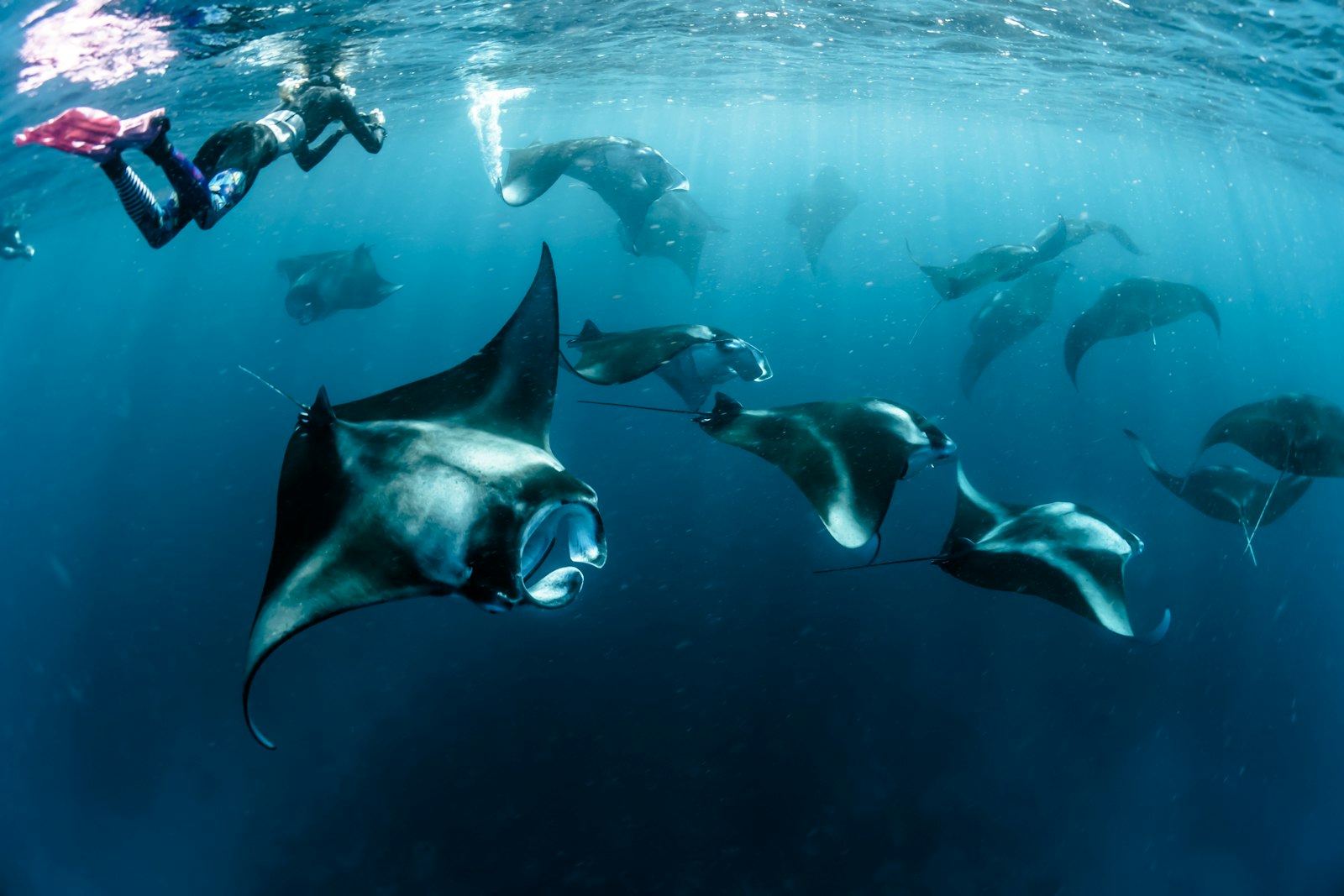
Mantas park-wide — present year-round at Manta Point, Karang Makassar, and Mawan. Larger aggregations occur roughly September through May, with the densest numbers reported December through February when cool, plankton-rich upwelling water drives feeding activity. This is the consensus from the majority of long-running operators; one operator quotes a different peak window, which tells you these are probability windows, not calendared events.
Park access — the park is open year-round. The 2019 proposed closure of Komodo Island was reversed. The practical constraint in peak season (July and August) is the 1,000 visitor per day park capacity, enforced through the SiORA allocation system. Prime boats on the most popular itineraries sell out six to twelve months in advance for peak dates. If you are planning a July or August trip, do not assume a last-minute slot will appear.
Minimum Experience Requirements
Komodo has a reputation for current. That reputation is earned. The Indonesian Throughflow — the water mass that moves between the Pacific and Indian Oceans through the Indonesian archipelago — squeezes through narrow straits and tidal channels. On spring tides and during the southeast monsoon, currents at sites like Shotgun, Crystal Rock, Castle Rock, and GPS Point can reach speeds that recreational diving equipment cannot fight. These dives are timed to slack water windows.
Practical gates that most operators enforce:
- Sheltered sites (Siaba Besar, Pink Beach, Tatawa Besar): Open Water certification, 10 to 20 logged dives is typically sufficient. These are appropriate for newer divers and are where check dives happen.
- Manta Point and moderate drift sites: Open Water with a reasonable log count and briefing. Current here is gentle to moderate and manageable.
- North Komodo high-current sites (Castle Rock, Crystal Rock, Shotgun, Tatawa Kecil): AOW certification. Many operators recommend 20 to 50 logged dives as a minimum; some guides suggest 50 to 60 dives for Castle Rock specifically. A DSMB — surface marker buoy — is required, and many operators expect every diver to carry one individually rather than sharing as a pair.
- GPS Point at Gili Banta and south Komodo exposed sites: AOW with confirmed drift diving experience. These are sites where a separated diver must manage a potentially long surface drift before pickup.
AOW can be completed during a liveaboard on some operators’ schedules. If you are currently Open Water certified and want to dive the full park, ask about combining an AOW course with your liveaboard booking — several operators build this in, and it is a genuinely good classroom for drift diving because you are learning in the actual conditions you will be diving.
All-Inclusive vs. What Gets Added: Reading the Price
An all inclusive komodo diving liveaboard quote typically means: accommodation on board, three meals per day plus snacks, filtered drinking water, and three to four guided dives per day with tanks and weights. What it often does not include: park and government fees (the IDR 300,000–400,000 per diver per day itemized above), rental dive gear, nitrox fills (on mid-range boats), airport transfers in Labuan Bajo, alcoholic beverages, and gratuities.
Budget boats almost universally charge separately for nitrox and rental gear. Mid-range boats vary — read the booking confirmation carefully. Luxury boats frequently include nitrox as standard but still itemize park fees separately because those fees are set by the government and subject to change after the boat’s pricing was published.
The 12-day grand crossing from Labuan Bajo to Bali carries an additional government fee layer on top of the daily park fees. Published examples show this adding roughly EUR 360 on top of the per-person cabin price, though the exact amount depends on the number of dive days spent within park boundaries.
Private Charter: The Alternative to a Shared Boat
If you are traveling as a group of eight or more, or if the idea of sharing a dive deck with strangers who have incompatible certification levels or surface interval preferences sounds unappealing, a private phinisi charter is worth pricing. The boat is yours, the itinerary is yours, and the guide-to-diver ratio is set by your group size rather than an aggregator’s booking formula.
We operate in partnership with Komodo Luxury, which runs a fleet of phinisi and purpose-built vessels out of Labuan Bajo. Private charter pricing is quoted on request because it depends on vessel, duration, group size, and season — the variables are too significant to publish a table that would be misleading. Use our enquiry form or WhatsApp to tell us your group size, preferred duration, and dates, and we will put together a specific quote rather than a bracket.
Logistics: Getting There and What to Expect on Arrival
Labuan Bajo is served by Komodo Airport (IATA: LBJ). International visitors connect via Bali (approximately one to one and a quarter hours flying time) or Jakarta (approximately two and a half hours). The main Indonesian carriers operating this route include Batik Air, Lion, Garuda, and Citilink. Flight options from Bali have expanded in recent years; there is no meaningful reason to do an overland approach for most itineraries.
Boats depart from the Labuan Bajo waterfront marina. Most operators ask you to be aboard by early to mid afternoon on embarkation day so the check dive can happen before sunset. Plan your inbound flight to arrive by noon at the latest. A direct Bali 08:00 departure comfortably clears customs, transfers you to the marina, and gets you aboard in time. Do not book a Bali connection that arrives at 14:00 and assume you will make it for a 16:00 check dive — that is a tight connection in practice.
The recompression chamber most operators reference is at Siloam Hospital in Labuan Bajo. This is a one to three hour evacuation from park dive sites. Dive insurance with emergency evacuation coverage is strongly recommended and effectively standard on any liveaboard operating in this region. If your travel insurance does not include hyperbaric treatment coverage, fix that before you board.
Our Five Duration Pages
This hub page gives you the framework. Each duration has its own detailed page with day-by-day site sequences, specific dive-site profiles, seasonal notes, and price ranges for that length of trip:
- 4-Day Komodo Liveaboard — Central and North loop, 10–12 dives, ideal entry point for experienced divers new to Komodo
- 5-Day Komodo Liveaboard — North + first south leg, 13–14 dives, shoulder-season flexibility
- 6-Day Komodo Liveaboard — Full park including south Komodo, 14–17 dives, the sweet spot for most divers
- 7-Day Komodo Liveaboard — Komodo complete + Gili Banta, first taste of Sumbawa, 18–21 dives
- 9-Day Komodo–Sumbawa Liveaboard — Full Sumbawa extension including Sangeang, Bima, Moyo, and Saleh Bay, 22–26 dives
Not sure which length suits your certification, schedule, or budget? Plan your trip with us. We know these boats and these routes, and we will tell you honestly which option fits your situation — even if it is the shorter, cheaper one.
Frequently Asked Questions
How many dives do you get on a Komodo liveaboard?
Most Komodo liveaboards schedule three to four dives per day on full diving days, including sunset or night dives on selected evenings. Day one is shortened by the embarkation check dive, and the last morning is typically one or two dives before returning to port. In practice: 4-day trips average 10–12 dives, 6-day trips 14–17 dives, and 9-day Sumbawa extensions 22–26 dives.
What is the komodo liveaboard price per cabin?
Per-person per-night rates run approximately USD 150–250 on budget shared-cabin phinisi, USD 300–500 on mid-range air-conditioned en-suite boats, USD 500–750 on premium mid-range vessels, and USD 800–2,000+ on luxury expedition boats. Park and government fees (approximately USD 18–27 per diver per day) are almost always quoted separately. Rental dive gear is usually extra on budget and mid-range boats.
Do you need Advanced Open Water for a Komodo liveaboard?
AOW certification is required for north Komodo routes that include Castle Rock, Crystal Rock, and Shotgun — the three sites with the strongest and most unpredictable current. Most operators also require it for south Komodo exposed sites and Gili Banta’s GPS Point. Open Water certification is sufficient for sheltered and moderate-current sites like Siaba Besar, Manta Point, and Tatawa Besar. If you are currently OW certified, several operators allow you to complete your AOW course during the liveaboard itself.
When is the best time to dive south Komodo on a liveaboard?
South Komodo — Manta Alley, Horseshoe Bay, Cannibal Rock — is conditions-dependent. The southeast monsoon from roughly June through August pushes Indian Ocean swell directly into these sites and makes them rough or undiveable. The reliable window is approximately October through early April, with November through February offering the strongest probability of calm water and active manta aggregations driven by nutrient-rich upwelling. Always confirm the planned south leg with your operator before booking if south Komodo is your primary goal.
Can you dive Komodo and Sumbawa on the same liveaboard trip?
Yes — 7 to 9-day itineraries routinely combine the full Komodo circuit with a Sumbawa extension covering Gili Banta, Sangeang volcano, Bima Bay, and Moyo or Satonda islands. The 12-day grand crossing continues to Bali. These extended routes are point-to-point, so you embark in Labuan Bajo and disembark in Sumbawa Besar, Lombok, or Bali depending on the itinerary. Repositioning flights back to your starting point need to be factored into the overall trip cost and logistics.