Labuan Bajo Diving: The Complete Expert Guide (Sites, Seasons, Honest Prices)

Lukas Wajong
May 17, 2026
18 min read
Labuan Bajo diving means accessing one of the most current-driven, macro-rich, and large-pelagic-active reef systems on the planet — roughly 70-plus named dive sites spread across Komodo National Park, operating from a single compact harbor town on the west tip of Flores. Every trip, whether a one-day boat run to Manta Point or a nine-day liveaboard crossing to Sumbawa, departs from this same waterfront. That is what makes scuba diving in Labuan Bajo logistically clean: one base, four distinct diving zones, and a season grid that determines which zones are safe on any given month.
This guide gives you the full picture — site by site, zone by zone, with honest price brackets, experience requirements, and the seasonal caveats that most booking pages skip. We operate day trips, liveaboards, and private dive charters in partnership with Komodo Luxury; no one can pay to alter what we write here, and if you use our free advice and proceed with a partner operator, that operator may pay us a referral fee at no extra cost to you.
The Four Diving Zones of Komodo National Park
Diving in Labuan Bajo Indonesia splits cleanly into four geographic zones. Understanding them is the first step to booking the right trip.
Zone 1 — Central Komodo (All-Year Core)
The workhorse zone for day trips: Siaba Besar, Mawan, Manta Point (Karang Makassar), Tatawa Besar, Batu Bolong. These sites sit roughly one to one-and-a-half hours from Labuan Bajo harbor by speedboat. Siaba Besar is calm and sheltered — five to eighteen metres, excellent for check dives and open-water graduates with ten or more logged dives. Batu Bolong runs five to thirty-five metres with medium-to-strong swirling current; an Advanced Open Water cert and some drift experience is the sensible floor. Tatawa Besar is the friendliest drift in the park — gentle to moderate, five to twenty-five metres, open-water accessible after ten to twenty dives, consistent fish life and soft coral.
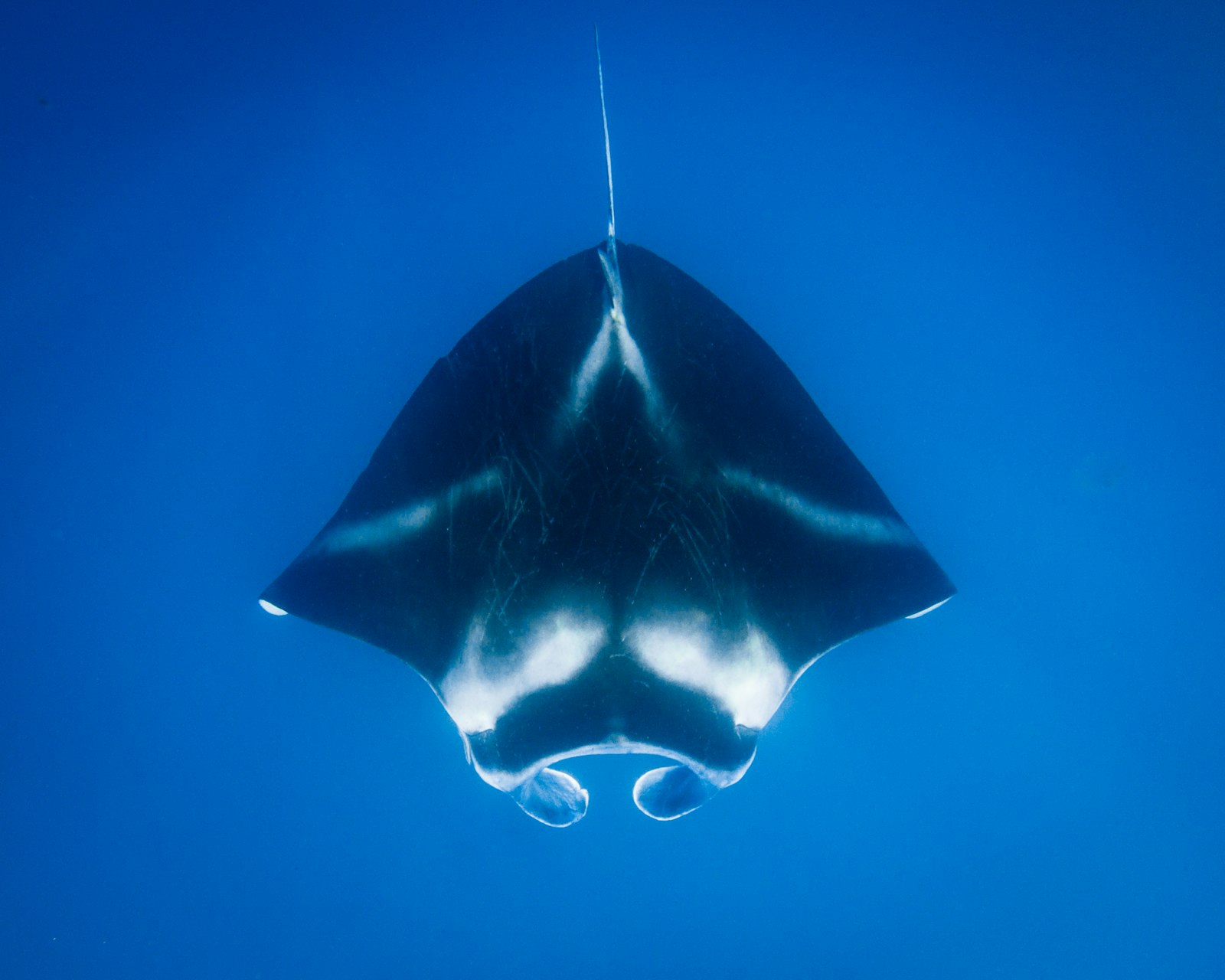
Manta Point (Karang Makassar) is a shallow plateau at eight to eighteen metres and diveable by all certification levels including snorkelers. Manta rays use cleaning stations here year-round; biggest aggregations run roughly from September through May, with December through February producing the densest numbers most years. We never guarantee sightings — no one can — but this is statistically the most reliable manta site in the park.
Zone 2 — North Komodo (Advanced, Seasonal)
Castle Rock, Crystal Rock, and the Shotgun channel (The Cauldron, between Gili Lawa Laut and Gili Lawa Darat) are the headline sites here. These are the dives that make Komodo famous globally. They are also the sites that demand respect.
Castle Rock sits on an open seamount north of Komodo Island. The plateau runs fifteen to twenty metres; the flanks drop to thirty to forty metres. Currents are strong to very strong. White-tip, black-tip and grey reef sharks hunt in the current; giant trevally and dogtooth tuna patrol the edges; barracuda school above the plateau. Most operators require Advanced certification and a minimum of thirty to fifty logged dives. Some guides I respect suggest sixty dives before Castle Rock — not because the certification says so, but because the down-current risk on the exposed flanks is real, and a diver who panics costs time that can matter.
Crystal Rock is an exposed pinnacle whose top breaks the surface at low tide. Split currents, ten to thirty metres. Advanced divers only. Shotgun runs ten to thirty metres through a narrow tidal funnel; the current accelerates as it funnels through, then spits divers into blue water at the exit — it is spectacular and it is not for anyone still building their drift skills.
North Komodo sites are reachable on day trips from Labuan Bajo, but it is a long run — expect over two hours by day boat each way. Liveaboards reach them with one overnight travel leg, which is part of why the three-day-plus format suits this zone better.
Zone 3 — South Komodo and Horseshoe Bay (Liveaboard Only, Seasonal)
Manta Alley, Cannibal Rock, Yellow Wall of Texas, Torpedo Point, Three Sisters, and German Flag. This is where the Indian Ocean pushes cold nutrient-rich water northward through the gap south of Komodo Island. The upwelling makes the water colder (expect twenty to twenty-five degrees Celsius, and bring a five-to-seven-millimetre suit with a hood), the visibility is often green-plankton rich, and the marine life density is extraordinary.
Cannibal Rock, off the south shore of Rinca in Horseshoe Bay, is legitimately one of the world’s top macro sites. The pinnacle runs five to thirty metres; the richest depth is fifteen to twenty-five metres. Sea apples, crinoids in every color, nudibranchs, rhinopias, pygmy seahorses on gorgonians, frogfish, leaf scorpionfish. Currents are mild to strong depending on tide; Advanced Open Water is the recommended floor.
Manta Alley sits at the south tip of Komodo Island, Indian-Ocean-exposed. Cleaning and feeding stations run ten to twenty-five metres; surge and moderate-to-strong current are standard. Negative-entry skills and Advanced certification are expected at every operator running this site.
South Komodo is not accessible on a standard day trip from Labuan Bajo. The transit time alone rules it out. You need a liveaboard with at least one overnight in the south, which typically means a six-day-plus itinerary. Best seasonal window for south sites is roughly October through April; July and August bring SE monsoon swell that makes the south rough and often undiveable.
Zone 4 — Sumbawa Extension (7–9 Day Liveaboards)
Gili Banta, Sangeang volcano, Bima Bay, Moyo Island, and Satonda Island. These sites are only visited on extended routes, typically seven to nine days, that cross the Sape Strait into Sumbawa waters.
Sangeang is an active volcano. Diving here means black-sand slopes with visible geothermal bubbling — champagne-gas streams through the coral at Bubble Reef, and the sand at Hot Rocks is literally warm under your fins. Flamboyant cuttlefish, wunderpus octopus, frogfish, ghost pipefish in the black sand. Current is mild to moderate on the lee side; intermediate divers handle it well. Night dives here are among the most memorable in Indonesia.
Gili Banta’s GPS Point is the opposite: an exposed seamount at fifteen to thirty-five metres with very strong current and genuine down-current risk. Experienced advanced divers only. Its K2 ridge is more forgiving — moderate-to-strong drift, schooling fusiliers and jacks, reef sharks, Advanced-comfortable level.
Saleh Bay (Teluk Saleh) on the longer eight-to-nine-day routes offers whale shark encounters at traditional bagan fishing platforms. These are aggregation-dependent and season-sensitive; the dry season months generally produce more reliable encounters. We do not promise whale sharks.
Day Trips vs Liveaboards vs Private Charter: Honest Tradeoffs
The format you choose shapes which sites you can reach and what kind of diving you actually experience.
| Format | Dives per day | Sites reachable | Night dives | Typical cost (before park fees) |
|---|---|---|---|---|
| Day trip (3-dive) | 2–3 | Central Komodo, some north sites | No | IDR 2.5–3.6M pp (≈USD 155–225) |
| Liveaboard 4D/3N | 3–4 incl. night | Central + North full loop | Yes | From ~USD 600 pp budget; USD 2,000+ luxury |
| Liveaboard 6D/5N | 3–4 incl. night | Central + North + South Komodo | Yes | From ~USD 1,000 pp budget; USD 3,000+ luxury |
| Liveaboard 8–9D | 3–4 incl. night | All four zones including Sumbawa | Yes | USD 2,500–4,500+ pp depending on vessel |
| Private charter (day boat) | 2–3 | Central + North Komodo | Possible | From ~USD 940/day for vessel + IDR 1M/day dive guide |
Day trips meet most divers’ needs for a two-to-three-day Labuan Bajo visit. The rhythm is consistent: meet at the harbor around 06:30, depart by 08:00, three dives plus lunch (often with an optional Padar hike or Komodo dragon trek worked in), back at the dock by 16:00–17:30. The limitation is transit time — central sites are one to one-and-a-half hours out, north sites add another forty-five minutes each way. That transit eats into bottom time and rules out south Komodo entirely.
Liveaboards eliminate the transit problem by sleeping on site. Three to four dives per day, including sunset and night dives that day-trippers simply cannot access. The check dive on day one is standard practice across all reputable operators — your guide needs to see you in the water before they take you anywhere with current.
Private dive charters suit groups of four to twelve who want full site control, flexible scheduling, and no strangers on the boat. The per-person economics improve substantially once the group is large enough. Plan your trip with us to discuss which format fits your group size, certification levels, and time in Labuan Bajo.
Labuan Bajo Diving Prices: What You Actually Pay
All figures below are observed market ranges as of 2025–2026; individual operators price differently and rates change with season and demand. Treat these as planning brackets, not fixed quotes.
Day Trip Prices
Three-dive day trips with equipment, guide, and lunch typically run IDR 2,500,000 to IDR 3,600,000 per person (approximately USD 155 to USD 225). Some operators quote two dives; confirm before booking. Bringing your own equipment often gets you a discount of around ten percent. Nitrox is sometimes included on premium day trips, sometimes an add-on.
Park and Government Fees
Park fees are almost always quoted separately from the dive price. The current structure for foreign divers runs roughly IDR 300,000 to IDR 400,000 per person per day (approximately USD 18 to USD 27). The base components are a marine park entry fee of IDR 250,000 per day plus a diver surcharge of IDR 25,000 per day. Some operators itemize an additional conservation fee; others bundle it differently. Confirm the exact itemization with your operator before travel. Ranger and trekking fees are separate again: Komodo and Rinca treks run IDR 200,000 per group of up to five people; Padar is IDR 150,000 per group.
Liveaboard Prices
Budget phinisi liveaboards run approximately USD 150 to USD 250 per person per night. Mid-range boats with en-suite cabins, nitrox included, and dedicated camera stations sit at USD 300 to USD 500 per person per night. Premium and luxury expedition vessels start at USD 500 per night and climb significantly from there. Government park fees — typically EUR 300 to EUR 400 equivalent for a six-to-nine-day crossing — are almost always billed separately on top of the per-person cabin rate. Rental dive equipment is also usually extra on liveaboards; bring your own computer and regulator if you can.
Courses
PADI Open Water courses arranged through Labuan Bajo dive operations run approximately USD 450 to USD 550 based on 2025–2026 observed quotes. Advanced Open Water runs a similar bracket. Discover Scuba Diving (try-dive) and refresher courses — we will give you accurate figures when you reach out, as pricing varies meaningfully by operator and current promotions.
Who Can Dive Where: Certification and Experience Floors
These are the experience gates operators apply in practice. They are not enforceable law, but any guide worth diving with will enforce them — including me. I would rather move someone to Siaba Besar than carry a passenger through Castle Rock.
- Open Water, 10–20 logged dives
- Siaba Besar, Siaba Kecil, Pink Beach, Mawan, Tatawa Besar, Manta Point / Karang Makassar, Padar area reefs. Calm to moderate current, five to twenty metres, manageable conditions.
- Advanced Open Water, 20–30 logged dives
- Batu Bolong, Manta Alley, Cannibal Rock, Yellow Wall of Texas, German Flag, Three Sisters. Moderate-to-strong current, variable conditions, depth down to thirty metres. You should be comfortable with negative entries and drift positioning before these.
- Advanced Open Water, 30–50+ logged dives with drift experience
- Castle Rock, Crystal Rock, Shotgun / The Cauldron, Tatawa Kecil. Strong to very strong current, documented down-current risk, unpredictable conditions. Some guides recommend sixty dives and a dedicated drift specialty before Castle Rock — that is a reasonable position.
- Advanced, experienced diver
- Gili Banta GPS Point, Manta Alley in surge conditions, south Komodo in strong upwelling periods. These sites can shift from manageable to demanding in one tidal phase.
A check dive on day one is not optional procedure at a well-run operation — it is how your guide calibrates your buoyancy and current-response before putting you somewhere where those things matter. If an operator skips the check dive and heads straight to Castle Rock, that tells you something about how they weight safety.
Seasons and Conditions: Month-by-Month Honest Grid
Komodo diving has no annual park closure. The question is which zones are diveable and in what conditions during any given month.
| Season | Months | North / Central Komodo | South Komodo | Visibility | Water temp (north) |
|---|---|---|---|---|---|
| Dry season peak | Jun–Aug | Excellent — calm, high vis | Rough, often undiveable (SE swell) | North: 20–35m; south: limited | 27–29°C |
| Dry season shoulder | Apr–May, Sep–Oct | Very good | South opens Oct onward | 15–30m | 26–28°C |
| Wet season / manta peak | Nov–Mar | Good most days; some north roughness Jan–Feb | Best south window; strong manta aggregations | South: 10–25m (plankton-green); north: 15–25m | South 20–25°C (upwelling), north warmer |
Manta rays are present park-wide year-round. The biggest aggregations — double-digit mantas at a single cleaning station — happen most reliably from December through February, within a broader September-to-May window. The counter-seasonal pattern is one reason experienced divers deliberately plan Komodo trips in the wet season: fewer boats, active south park, peak manta numbers, and lower accommodation prices in Labuan Bajo town.
The peak tourist months of July and August produce the best north Komodo visibility but also the highest demand. The park operates under a visitor cap of 1,000 people per day; liveaboard slots for peak July and August are typically booked six to twelve months in advance. Allocation runs through the SiORA app system. If your preferred dates are within four months, check availability now.
Getting to Labuan Bajo
Komodo Airport (LBJ) in Labuan Bajo is served by domestic carriers — Batik Air, Lion Air, Garuda, and Citilink among them. International visitors connect through Bali (DPS, approximately one to one-and-a-quarter hours) or Jakarta (CGK, approximately two-and-a-half hours). Direct regional connections from Singapore and Kuala Lumpur have operated seasonally on low-cost carriers; check current schedules, as these routes change.
From the airport to the harbor is roughly fifteen minutes by taxi. Day-trip boats depart from the Labuan Bajo waterfront. Liveaboards typically embark at the marina; your boat will confirm the exact jetty.
One logistics note worth planning around: if you are flying out of Labuan Bajo after diving, schedule a minimum of eighteen hours between your last dive and your flight. This is standard flying-after-diving practice, not specific to Komodo — but it catches people who book a 06:00 morning flight the day after a three-dive day trip.
Safety: Currents, Equipment, and Emergency Cover
Komodo currents are driven by the Indonesian Throughflow — Pacific water pushing into the Indian Ocean through a chain of narrow straits, funneled and amplified by tidal exchange. Currents of seven to eight knots on spring tides and SE monsoon months are documented; recreational dive windows target the 0.5 to three-knot tidal slack. Down-currents and washing-machine turbulence are specific hazards at Shotgun, Tatawa Kecil, Crystal Rock’s flanks, Batu Bolong’s exposed sides, and Gili Banta’s GPS Point. These are the sites where separation events happen. Every operator running these sites should be briefing lost-diver protocol explicitly: search ten seconds, then ascend safely, deploy your DSMB, drift, and wait for the boat.
Equipment minimums for current Komodo diving: your own dive computer (non-negotiable), a DSMB (minimum one per buddy pair, increasingly expected per diver), whistle or audible signal, and a light for anything deeper than twenty metres or any night dive. Reef hooks — if your operator allows them — are only ever deployed on bare rock or rubble. Never live coral. Follow your operator’s specific policy; policies differ.
Operators report that the nearest hyperbaric recompression facility is Siloam Hospital in Labuan Bajo town. Evacuation from dive sites runs one to three hours depending on position and sea state. Dive accident insurance covering recompression treatment and medical evacuation is strongly recommended; major policies include DAN and DAN Asia-Pacific. Verify your coverage before you travel.
PADI Courses in Labuan Bajo
Open Water, Advanced Open Water, Discover Scuba Diving, and refresher courses are available through certified dive operations in Labuan Bajo. Pool or confined-water sessions typically happen in calm bays around the archipelago; open-water training dives run at sheltered sites like Siaba Besar. The AOW course is a logical add-on for anyone who arrives as an Open Water diver and wants to access north Komodo or south park sites — some liveaboards integrate AOW training during the trip itself, combining course dives with the itinerary.
If you are thinking about getting certified or upgrading your cert before or during a Komodo trip, use our enquiry form or reach us on WhatsApp — we can match you with the right operation and timing given your schedule.
Conservation and Conduct in the Park
Komodo National Park is a UNESCO World Heritage Site. Indonesia declared its entire EEZ a manta ray sanctuary in 2014 — the world’s largest such sanctuary at the time — making the mantas at Karang Makassar and Manta Alley legally protected throughout Indonesian waters. In-park rules are consistent: no touching, no collecting, no gloves (wearing gloves encourages touching), no anchoring on reefs. The popular sites run a mooring buoy system; operators tie to buoys, not coral.
Manta etiquette is specific: maintain at least three metres distance, approach from the side or slightly below, never from above or directly in front, do not block their path or chase them off a cleaning station. Stay low, move slowly, let them come to you. A manta that chooses to approach will often circle repeatedly; a manta that has been chased will simply leave.
Ready to Plan Your Komodo Diving Trip?
Whether you are booking a single day trip around Manta Point or building a nine-day Sumbawa crossing, the best first step is a conversation about your certification level, time available, and which sites matter most to you. We will be honest if the trip you are imagining requires more experience than you currently have — and we will suggest the route that will actually work rather than the one that sounds most impressive.
Contact us on WhatsApp at +62 811-3882-3875 or use our enquiry form to start planning. We respond quickly and we know these waters.
Frequently Asked Questions
Can a beginner do scuba diving in Labuan Bajo?
Yes — several sites in central Komodo are well within Open Water diver ability. Siaba Besar (the turtle aggregation site), Tatawa Besar, Pink Beach, and Manta Point all run calm to moderate conditions at depths of five to twenty metres and are regularly dived by certified beginners with ten or more logged dives. North Komodo sites like Castle Rock and Crystal Rock are not appropriate for beginners, and any operator telling you otherwise should be questioned. Start with the central sites, do your check dive honestly, and build from there.
What are the Komodo National Park diving fees for 2025–2026?
Foreign divers should budget approximately IDR 300,000 to IDR 400,000 per person per day in park and government fees. This covers the marine park entry fee (IDR 250,000/day), a diver surcharge (IDR 25,000/day), and a harbour fee, with some operators adding a conservation levy. Park fees are almost universally quoted separately from dive trip prices — they are not included in the IDR 2.5–3.6 million day-trip price brackets. Ranger and trek fees for Komodo island and Rinca are additional and charged per group.
What is the best month to dive Komodo?
There is no single best month — it depends on which zone you prioritise. For north Komodo in peak visibility conditions (25–35 metres) with the calmest seas, July and August are hard to beat. For south Komodo and maximum manta aggregations, December through February is historically the strongest window, within a broader September-to-May active period. If you want both zones accessible and reasonable weather, April to May and October to November are solid shoulder-season choices with shorter booking lead times than peak summer.
Do I need Advanced Open Water to dive Komodo?
Not for all of Komodo. Central sites including Manta Point, Siaba Besar, Tatawa Besar, and Mawan are open to Open Water divers. Advanced Open Water certification — and demonstrated drift-diving comfort — is required by reputable operators for north Komodo (Castle Rock, Crystal Rock, Shotgun) and south Komodo (Manta Alley, Cannibal Rock). Liveaboards running north-park itineraries typically require AOW as a minimum before boarding. The good news is that the AOW course itself is achievable on a liveaboard trip.
Is a day trip or liveaboard better for Komodo diving?
It depends on your time and objectives. Day trips work well for two-to-three-day visits and access central and some north Komodo sites efficiently. Liveaboards unlock night dives, south park sites (Cannibal Rock, Manta Alley) that are impossible on a day trip, and the Sumbawa extension with Sangeang volcano. The honest tradeoff: a three-day run of good day trips at central sites gives you six to nine quality dives; a four-day liveaboard gives you twelve to sixteen dives including night dives and a far wider site range. If you have six days or more and are Advanced-certified, a liveaboard almost always delivers better diving per day.