Batu Bolong: Komodo’s Iconic Pinnacle — and Why It’s Not for Beginners

Lukas Wajong
April 17, 2026
16 min read
Batu Bolong is a submerged central pinnacle in the Komodo National Park, sitting roughly midway between Komodo Island and the Tatawa group, and it is the most fish-dense dive site in the region. The reef runs from about 5 metres at the summit down to 35 metres on the flanks, and it hosts one of the highest concentrations of reef fish biomass recorded anywhere in the Coral Triangle. It is also a site that should only be dived by Advanced Open Water divers or confident intermediates with meaningful drift-diving experience — and it is absolutely closed to snorkelers. If you have arrived here wondering whether Batu Bolong suits your level, read every section before booking.
What Makes Batu Bolong Different
Most popular dive sites in Komodo have a directional current — the water flows predictably one way, divers drift along a reef wall, and the guide reads the tide table and picks the right window. Batu Bolong does not work that way. Because the pinnacle is completely isolated in open water, the current hits it from every angle depending on the tidal cycle and the season, wraps around the structure, and produces eddies on the lee side that shift without warning. On the exposed north face during a running tide, a confident AOW diver can feel the surge pulling them down the slope and away from the reef. That is the documented down-current risk guides brief you on at every operator running this site.
Guides respond by keeping the group in the protected lee — usually the west or southwest face depending on conditions — and staying extremely tight. The standard group size at responsible operators on current sites is four to six divers per guide, and at Batu Bolong most will stay closer to four. You will not be exploring freely. You will be staying within an arm’s length of your guide’s position, ascending on their signal, and deploying your DSMB before you leave the reef. If that briefing sounds constraining, it is worth asking yourself whether this is the right site for your experience level right now.
Site Profile at a Glance
- Location
- Central Komodo National Park, between Komodo Island and Tatawa Besar; approximately 1–1.5 hours by speedboat from Labuan Bajo harbour
- Depth range
- 5–35 m (most productive diving 10–25 m)
- Current character
- Medium to strong, swirling and unpredictable; down-current risk on exposed faces
- Minimum level
- Advanced Open Water (AOW) or a confident intermediate with drift experience — Open Water alone is not sufficient
- Snorkeling
- Not permitted. Snorkelers are banned from this site. This is not an operator preference; it is a site-access rule enforced at this pinnacle because the surface current and boat traffic make it genuinely unsafe for mask-and-fins visitors.
- Best conditions
- Dry season approximately April through October; visibility typically 15–25 m, sometimes higher in peak dry season
- Dive duration
- Typically 45–60 minutes depending on depth profile and current
- Park fees
- Expect IDR 300,000–400,000 per diver per day (marine entry + diver surcharge + harbour fee; exact itemisation varies by operator); fees are normally excluded from day-trip prices — confirm before you book
The Fish Life: What You Will Actually See
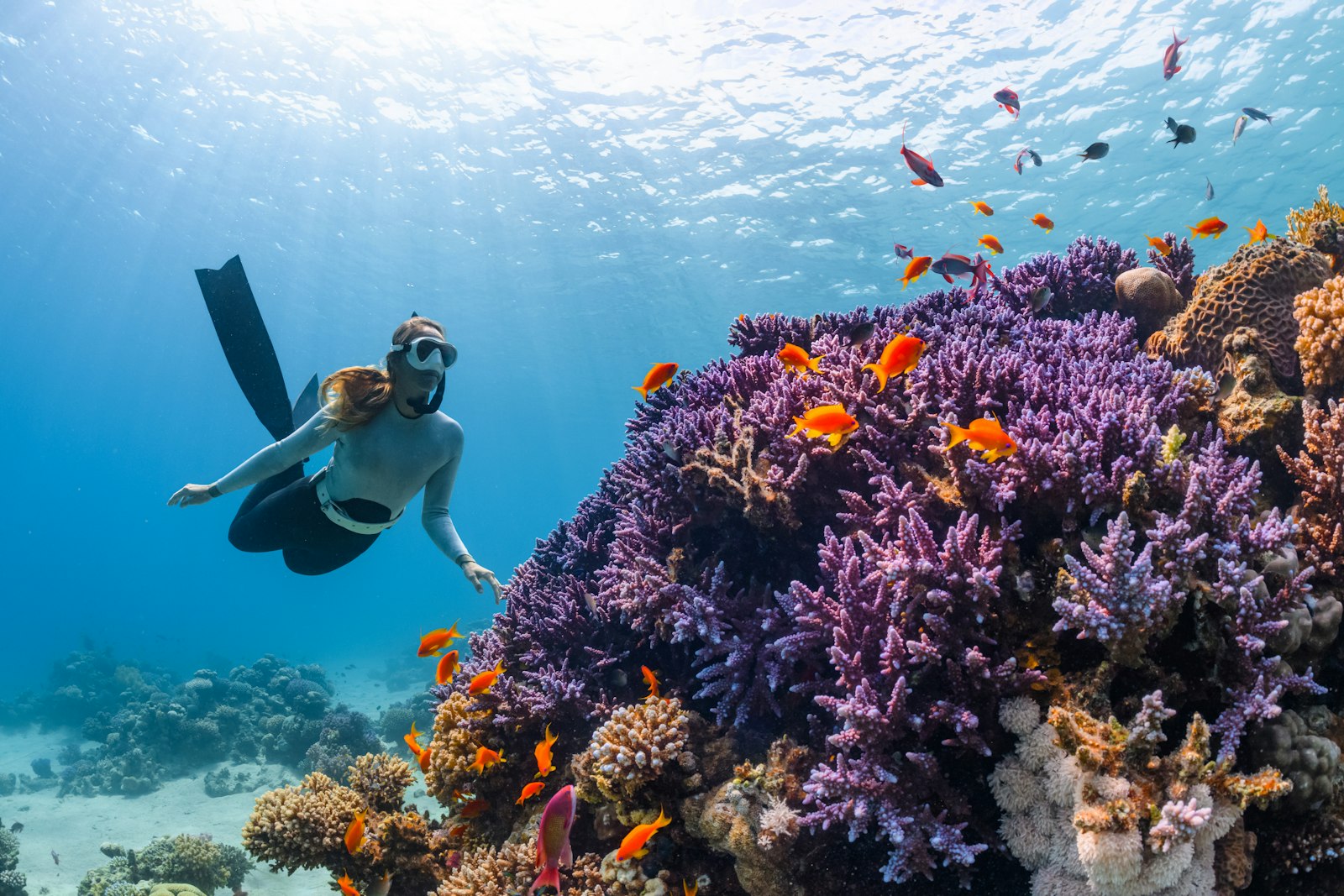
This is where Batu Bolong earns its reputation. The pinnacle has been measured by survey teams as one of the highest-biomass reef structures in the Coral Triangle, and the reason is simple: clean, current-swept water delivers a continuous feed of plankton, and the reef provides shelter. The result is a living wall of fish that can be genuinely disorienting the first time you see it.
Fusiliers and anthias move in dense schools across every face of the reef. Surgeonfish and snappers hold position in the current. Above them, large groups of big-eye trevally and giant trevally patrol the blue water just off the structure, and the occasional dogtooth tuna punches through mid-water without warning. Deeper on the flanks, Napoleon wrasse appear with the nonchalant confidence of fish that have not been harassed in decades. Green and hawksbill turtles rest on the coral or graze algae-encrusted ledges; you will likely see two or three on a single dive.
Whitetip reef sharks are regulars, usually resting on the sand patches between coral heads at 20–28 metres. On a good current day, grey reef sharks appear in the blue water off the exposed faces. These are not dramatic hunting scenes. They are sharks doing what sharks do in a protected park — moving unhurriedly and mostly ignoring divers who stay calm and slow.
The coral structure itself deserves a mention. Because the site is in the current pathway, hard corals have developed into large table formations and dense staghorn thickets. Soft corals — sea fans, whip corals, branching gorgonians — are thick on the current-facing surfaces. The deeper flanks carry encrusting and massive coral formations with significant age. None of this is background scenery. It is a functioning reef, not a dive-site backdrop.
One caveat: marine life varies with season, tidal conditions, and the kind of luck that is simply not predictable. No guide, no operator, and no website should promise you that you will see Napoleon wrasse or sharks on a specific dive. What the site reliably delivers is fish biomass and live coral. Everything else is genuinely subject to the ocean’s schedule.
Is Batu Bolong Suitable for Beginners?
No. Directly and without qualification: Batu Bolong is not a suitable site for Open Water divers, and it is not the place for anyone on their first drift dive or their first current-site experience. Here is the honest reason.
An Open Water certification prepares you for controlled conditions to 18 metres with a guide. It does not train you for multi-directional current, down-current risk, or the kind of rapid situational assessment that a swirling pinnacle requires. The problem is not that an OW diver would necessarily get into serious trouble on a calm day — it is that Batu Bolong does not reliably offer calm days, and conditions that look manageable at the start of a dive can shift significantly mid-water. A diver without drift experience will be a passenger rather than a participant, and a passenger on an exposed pinnacle diverts guide attention from the whole group.
If you hold an Open Water certification and you want to dive Komodo, there are excellent sites matched to your level right now. Siaba Besar is the best introduction to the park: sheltered, calm, 5–18 metres, with the highest turtle density in the region. Tatawa Besar offers a gentle drift along a sloping reef with soft coral gardens and the occasional manta. Manta Point (Karang Makassar) runs at a mild to moderate drift pace and is accessible to all certification levels including snorkelers. These are not consolation-prize sites. They are genuinely beautiful dives. Start there, build some drift experience, and Batu Bolong will still be here.
For divers who want to fast-track: completing your Advanced Open Water course in Labuan Bajo before the trip, or during a liveaboard, opens the full range of north and central Komodo sites. Your AOW deep and navigation dives can be completed in the same waters you will be exploring. It is worth doing properly rather than arriving under-qualified and watching from the boat.
Ready to figure out the right sites for your certification and logged dives? Use our enquiry form or reach us on WhatsApp — we will match you to a day trip or liveaboard itinerary honestly, even if that means recommending the option that costs less.
Batu Bolong on a Day Trip vs a Liveaboard
Batu Bolong appears on both day-trip itineraries from Labuan Bajo and liveaboard route plans, but the experience differs in one practical way: timing.
On a day trip, the boat has a fixed schedule that must account for travel time from the harbour (roughly 1–1.5 hours each way by speedboat), park logistics, and usually a second or third dive site. The guide picks the tidal window that suits Batu Bolong best on that day, but the window is what it is. Day trips from Labuan Bajo typically depart between 07:30 and 08:00, and the Batu Bolong dive usually falls mid-morning when tidal conditions are most predictable for central sites. Day-trip pricing for three dives with equipment runs roughly IDR 2,500,000–3,600,000 before park fees, depending on the operator and the boat; park fees add IDR 300,000–400,000 per diver per day on top.
On a liveaboard, the captain can position the boat on the mooring at Batu Bolong at any hour and wait for the right slack-water moment. That flexibility matters on an exposed pinnacle with unpredictable currents. Early morning dives at Batu Bolong, when the light angles down through the water column and the current is often briefly slack before the tide turns, are a different dive from the same site at mid-tide. Liveaboard routes that include Batu Bolong typically also carry Castle Rock, Crystal Rock, and the Shotgun channel — the full north and central Komodo package — which is a logical grouping because all four require AOW and benefit from guide knowledge of local tidal cycles.
Neither format is inherently superior for this site. A well-run day trip with an experienced guide on the right tide is an excellent dive. A liveaboard gives you more options for timing and the ability to do a second dive when conditions reset. The right choice depends on how many days you have, your budget, and whether you want the south Komodo sites and night dives that are only reachable on multi-day trips.
| Factor | Day Trip from Labuan Bajo | Liveaboard |
|---|---|---|
| Typical tidal timing | Fixed by boat schedule; guide selects best window available that day | Flexible; captain can hold for optimal slack water |
| Dives at this site | Usually 1 dive per trip | 1–2 dives possible (morning + conditions-permitting repeat) |
| Other sites same day | Typically Manta Point, Tatawa Besar, or Tatawa Kecil on same itinerary | Castle Rock, Crystal Rock, Shotgun on same liveaboard route |
| Indicative cost (diver) | IDR 2,500,000–3,600,000 + IDR 300,000–400,000 park fees | Typically included in 4D/3N liveaboard from approx. USD 600 budget end |
| Night dives | Not available (day trip only) | Available at other sites on same route (Wainilu, Torpedo Point) |
| AOW required? | Yes — this site specifically | Yes — required for most north and central Komodo liveaboard itineraries |
The Snorkeler Ban: Why It Exists
Some visitors arrive at Batu Bolong expecting to join the surface while their diving companions go below. This is not allowed, and the reason is not arbitrary. The pinnacle sits in open water with significant surface current. A snorkeler in the water at a site with multi-directional current and unpredictable upwelling has no reliable way to hold position above the dive group. Boat traffic — from the operator’s own vessel manoeuvring, plus other operators on the same mooring — creates additional surface hazard. The ban exists because the site is genuinely unsafe at the surface without the ability to control your position and ascent, which requires scuba equipment and the training to use it.
If you are travelling with a non-diving companion or a snorkeler who wants to see Komodo’s marine life, the honest answer is that many other sites in the park work very well for them: Pink Beach, Manta Point, Siaba Besar, and Mawan all allow snorkeling, and Manta Point in particular can deliver manta ray encounters from the surface. We cover this in detail on our dive sites hub. A mixed diver-snorkeler group can absolutely have a full day on the water — it just needs to be planned around sites where both are safe and appropriate.
Safety Briefing: What Every Diver Needs to Know Before Entering
This section is not boilerplate. Batu Bolong demands specific preparation. Every guide at any competent operator will cover these points, but you should know them before you board the boat.
Down-current awareness
The exposed sides of the pinnacle — particularly the north and northeast faces during incoming tidal flows — can generate downward pull without obvious visual warning. The water looks clear and the current feels horizontal until it is not. The protocol is to stay on the reef, keep visual contact with the structure at all times, and ascend immediately if you feel yourself being pulled off the wall into blue water at depth. Do not fin hard to fight a down-current. Signal the guide, establish neutral buoyancy, and follow their lead to the lee side.
Group discipline
This is not a site for independent exploration. Stay within visual range of your guide — not buddy range, guide range. The eddies on the lee side can separate a buddy pair from the group within seconds if one diver drifts slightly wide. Tighten up before the descent and do not wander toward any face the guide has not cleared.
DSMB deployment
Bring one per buddy pair at minimum; one per diver is increasingly the standard at Komodo operators. You will ascend in open water at this site, not up a reef wall. A deployed surface marker buoy is the only thing telling the skipper where you are. Practice deploying it on a calm dive before you attempt it in moving water above an exposed pinnacle.
Computer and depth discipline
Most guides will tell you the action is 10–25 metres. There is no reason to go to 35 metres at Batu Bolong on a recreational dive — the fish biomass is densest in the mid-water column at 12–20 metres, and pushing deep on a current site shortens your no-decompression limit when you may need to ascend quickly. Bring a dive computer. Komodo operators expect it.
Reef hooks
Operator policy on reef hooks is split in Komodo. Some allow them on bare rock or rubble only — never on live coral — as a way to hold position in current and observe marine life without kicking up sediment or gripping the reef. Others ban them entirely for guests. Follow your specific operator’s briefing on this. If your guide says no hooks, the answer is no hooks.
How Batu Bolong Fits Into Komodo Dive Trip Planning
Most itineraries that include Batu Bolong pair it with nearby central and north sites. On a typical 4-day/3-night liveaboard, Batu Bolong appears on day two alongside Manta Point, with north Komodo sites (Shotgun, Castle Rock, Crystal Rock) reserved for day three when the guide has had a check dive to assess the group’s current-handling ability. That sequencing is deliberate. You do not want Batu Bolong to be your first current dive of a trip.
On a day trip, the most common combination is Batu Bolong plus Tatawa Besar plus either Manta Point or one of the Tatawa Kecil walls. Some operators pair it with a Padar trek in the afternoon, which works logistically because Padar is en route between the central sites and the return to Labuan Bajo. Park ranger fees for Padar trekking are IDR 150,000 per group of up to five people, separate from dive fees.
If you are planning your first Komodo trip and Batu Bolong is on your target list, the minimum sensible preparation is an Advanced Open Water certification plus at least ten to fifteen logged dives post-certification, with at least a few of those in moving water. Arriving with your AOW and forty logged dives gives every guide you will encounter in Komodo the confidence to take you to the full range of central and north sites without reservation. Arriving with an OW and twenty dives, all done in a quarry or a calm resort lagoon, means some guides will — correctly — redirect you.
We are not in the business of telling you what you want to hear. If you are not at the right level for this site yet, we will tell you, and we will suggest what you can do about it — whether that is booking an AOW course in Labuan Bajo first, building dives at the more forgiving central-park sites, or planning your next trip once you have the experience. That is the more useful conversation, and it is one you can start with us directly.
Send us your dive log details via our enquiry form, or reach the planning desk on WhatsApp — tell us your certification, logged dives, and what you want to see, and we will put together an honest recommendation for your specific situation.
Frequently Asked Questions
Is Batu Bolong suitable for beginners or Open Water divers?
No. Batu Bolong requires Advanced Open Water certification as a minimum, and most guides want to see actual drift-diving experience alongside that certification. The site has unpredictable multi-directional current and documented down-current risk on its exposed faces. Open Water divers are better matched to Siaba Besar or Tatawa Besar, both of which offer outstanding diving at their level within Komodo National Park.
Can snorkelers go to Batu Bolong?
No. Snorkelers are not permitted at this site. The surface current at an isolated open-water pinnacle is genuinely hazardous for anyone without scuba equipment and the training to control their depth and ascent. If you want to snorkel in the park, Manta Point, Pink Beach, and Siaba Besar are appropriate sites where snorkeling is allowed and the conditions are manageable.
What is the best time of year to dive Batu Bolong?
The dry season window from approximately April through October gives the most reliable conditions for north and central Komodo sites including Batu Bolong. Visibility in peak dry season (July–August) typically runs 20–30 metres or more. The site is dived year-round, but January and February can bring rougher seas on the crossing from Labuan Bajo and reduced visibility. Check the seasonal windows carefully if you are planning a wet-season trip.
What marine life should I expect at Batu Bolong?
The site reliably delivers very high fish biomass — dense schools of fusiliers, anthias, snappers, and surgeonfish, with Napoleon wrasse, turtles, giant trevally, and whitetip reef sharks as regular sightings. Grey reef sharks appear on current-active dives. Soft and hard coral coverage is extensive. No guide should promise you specific sightings on a specific day; what the site consistently offers is the richest fish density in the Komodo park, and most dives here are genuinely memorable for that reason alone.
How do I reach Batu Bolong from Labuan Bajo?
By day-trip speedboat the crossing takes roughly 1 to 1.5 hours from Labuan Bajo harbour. Most day trips depart between 07:30 and 08:00 and return by 16:00–17:30. The site also appears on most 4-day and longer liveaboard itineraries operating from Labuan Bajo. Park entry fees apply on both formats — expect IDR 300,000–400,000 per diver per day, not including equipment hire or course fees where applicable.