Minimum Dives for a Komodo Liveaboard (and for Castle Rock): Real Experience Floors

Ingrid Mathiesen
December 20, 2025
15 min read
The minimum dives for a Komodo liveaboard depend entirely on which route the boat is running. For a central-park itinerary that stays off the exposed north pinnacles, most operators accept an Open Water certification and roughly 10–20 logged dives. For a north-current route that includes Castle Rock, Crystal Rock, or Shotgun — the sites people come specifically to dive — the standard minimum is Advanced Open Water with commonly 20–50 logged dives, and at least one well-regarded operator on the ground recommends 50–60. That gap matters. If you book the wrong trip, you will sit out the best dives.
I have spent a lot of seasons running routes through this park and I have watched the pattern repeat: the guest with 18 dives and a fresh OW card who thought “any liveaboard” meant access to everything. The check dive on day one tells the real story. This article gives you the honest breakdown so you can book a trip that matches where you actually are, not where you wish you were.
Why Komodo Currents Set the Bar
Komodo’s currents are not a marketing story. The Indonesian Throughflow pushes Pacific water toward the Indian Ocean — a pressure-driven conveyor of 15–20 sverdrups squeezing through narrow straits. On spring tides and during the SE monsoon (June–August), flows through the Linta and Sape straits can hit 7–8 knots. Recreational dives are timed for the 0.5–3 knot windows around slack, but that window can be short, and the current on the edges of exposed seamounts does not read the same as the current in the channel.
What makes the north-park sites genuinely demanding is not raw speed alone. It is the combination of down-currents on exposed flanks, split currents around submerged pinnacles, and the fact that the “washing machine” at sites like Shotgun or the Cauldron ejects you into open blue water. At Castle Rock, the plateau sits at 15–20 m with flanks dropping to 30–40 m. If the current catches you on an edge, a 500 m lateral drift in a few minutes is not unusual. An experienced diver reads the water, deflates quickly, tucks behind the reef, and ascends on the protected side. A diver with 18 dives and no drift experience does not have those reflexes yet. It is not a confidence question. It is a repetitions question.
The Site-by-Site Experience Gates
The table below reflects what operators commonly apply in practice. These are policies, not law — no Indonesian regulation mandates a specific logged-dive count. But reputable operators enforce them because their boat, their guide, and ultimately their operating licence sit inside that water with you.
| Site | Zone | Depth typical | Current character | Minimum cert | Logged dives (typical operator floor) |
|---|---|---|---|---|---|
| Siaba Besar (Turtle City) | Central | 5–18 m | Sheltered, calm | Open Water | 10–20 (check-dive site) |
| Manta Point / Karang Makassar | Central | 8–18 m | Gentle–moderate plateau drift | Open Water | 10–20 with briefing |
| Tatawa Besar | Central–North | 5–25 m (action 10–20 m) | Gentle–moderate drift | Open Water | 10–20 |
| Mawan | Central | 5–25 m (action 10–18 m) | Mild–moderate drift | Open Water | 10–20 |
| Pink Beach / Padar area | Central | 2–20 m | Mild, fringing reef | Open Water | Any (beginner-friendly) |
| Batu Bolong | Central–North | 5–35 m | Medium–strong, swirling, unpredictable down-currents on exposed sides | Advanced Open Water | 20–30+ |
| Tatawa Kecil | North | 10–30 m (plateau 5–10 m) | Very strong, split currents around islet | Advanced Open Water | 30–50 |
| Castle Rock | North | 15–20 m plateau, flanks to 30–40 m | Strong–very strong; down-current risk on edges | Advanced Open Water | 30–50 typical; 50–60 recommended by some guides |
| Crystal Rock | North | 10–30 m+ | Challenging, split currents | Advanced Open Water | 30–50 |
| Shotgun / The Cauldron | North | 10–30 m (channel crossing ~15–20 m) | High-speed tidal funnel, ejects into blue water | Advanced Open Water, drift experience required | 30–50 |
| Manta Alley (south Komodo) | South — seasonal | 10–25 m | Moderate–strong, surge, Indian-Ocean-exposed | Advanced Open Water; negative-entry skills | 25–50 |
| Cannibal Rock / Horseshoe Bay | South — seasonal | 5–30 m (richest 15–25 m) | Mild–strong by tide; thermoclines, cold upwelling | Advanced Open Water | 20–30 |
| Gili Banta — GPS Point | North–Sumbawa crossing | 15–35 m+ (action 20–30 m) | Very strong, washing-machine, negative entries; down-currents | Advanced Open Water, experienced only | 50+ |
What a Liveaboard Typically Requires
Most liveaboards operating north-current itineraries — the routes that visit Castle Rock, Crystal Rock, and Shotgun — list Advanced Open Water as a formal requirement for those specific dives, and a minimum log count in the range of 20–50 depending on the operator. Some are stricter; a few are looser. The written policy on a booking page and what actually happens on the check dive can differ, and experienced guides usually make the call at the water’s edge on day one.
The check dive is universal. Every reputable liveaboard in Komodo does one. It is not a formality. The guide is watching your buoyancy, your response to current, how you handle a descent in moving water, and whether your gear configuration is going to cause a problem at 25 m. Most operators use Siaba Besar or a similar sheltered central site for this. A diver who struggles with buoyancy control in calm water at Siaba will not be cleared for Castle Rock — regardless of what the log book says.
For liveaboards staying on central-park routes (Manta Point, Tatawa Besar, Pink Beach, Siaba, Mawan, dragon trek, night dive at Wainilu), Open Water with 10–20 dives is workable and the diving is genuinely excellent. The manta encounters at Manta Point can be among the best in the world. You are not getting a lesser experience — you are getting a more appropriate one, and returning ready for the north when your log book earns it.
Neptune’s phrasing, which I find honest
Neptune Liveaboards puts it plainly in their publicly available material: AOW required for north routes, and they sell the AOW course during the trip itself for divers who want to complete it mid-crossing. That is a legitimate option if you are close to the threshold but not quite there. You do the qualification dives during the crossing, you complete AOW on board with a certified instructor, and by day three or four you are cleared for the current sites. It is not cutting corners — the AOW training dives happen in real Komodo conditions, which is about as thorough a classroom as exists.
Can You Dive Castle Rock with Open Water and 20 Dives?
Usually no. And I am going to be specific about why rather than just saying the current is strong.
Castle Rock is an open-water seamount. The plateau at 15–20 m is accessible in calm conditions, but the current does not stay calm the whole dive. At the edge of the plateau, where the white-tip sharks and the GTs are hunting, the water is moving. If you drift off the edge, you are on a 30–40 m flank in moving water and you need to respond correctly — inflate immediately, find a rock to hold, and make a controlled ascent. A diver with 20 dives in sheltered tropical conditions has not been in that situation. They lack the automatic response.
The honest answer to “can I dive Castle Rock with OW and 20 dives?” is: some operators might let you, particularly in flat conditions on a calm day at slack tide. A few do. But most of the experienced operators on this route will not clear you, and the ones who are cutting corners on that policy are the ones whose boats I would not want to be on for other reasons too.
The better question is: what do you need to do to earn Castle Rock? Complete AOW. That gives you the navigation, buoyancy, and deep dives. Then build drift experience — even three or four proper drift dives in a predictable current will change your water-reading ability. By 30–40 logged dives with those skills in the book, you are genuinely ready.
Ready to plan a trip that matches your level? Use our enquiry form or reach us on WhatsApp — we will tell you honestly which itinerary fits, and which to save for your next visit.
Building Experience Before You Arrive: Use the Sheltered Sites First
If you are planning a Komodo liveaboard and currently sitting at 15–25 dives, the most useful thing you can do is build your log in conditions that develop the specific skills Komodo demands.
Siaba Besar
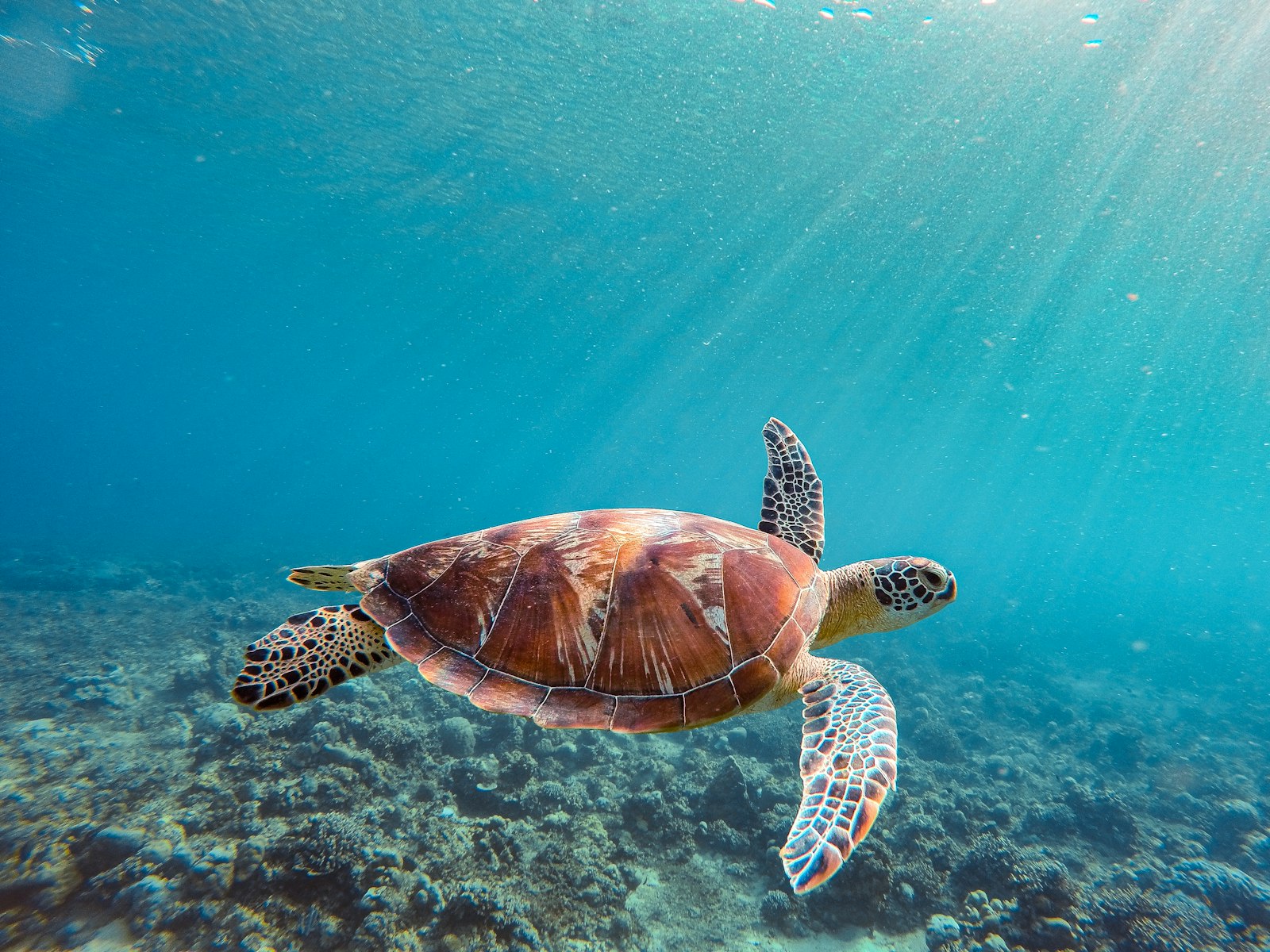
This is where most Komodo liveaboards do the day-one check dive, and for good reason. The water is sheltered, the depth tops out around 18–20 m, and the current is minimal. Turtles are everywhere — green and hawksbill both. For OW divers, this is the site to get comfortable with your buoyancy, your air consumption, and your buddy communication in tropical conditions before anything demanding happens. A guide watching you at Siaba can tell a lot about how you will handle the north sites two days later.
Tatawa Besar
Tatawa Besar is the step up. The depth runs to 25 m, the current is a gentle-to-moderate drift along a sloping reef, and on a good day you will see turtles, reef sharks, and if the timing is right, a manta passing overhead. This is the site where you practice reading drift — going with the current deliberately, controlling your depth while moving laterally, and descending into moving water without panicking. It is OW-accessible, but it rewards focused attention. Divers who do Siaba and Tatawa Besar back-to-back in good conditions come off that second dive genuinely better prepared for what comes next.
Manta Point / Karang Makassar
The plateau at Manta Point runs for roughly 3 km and sits between 8–18 m. The current here is gentle to moderate, and the dive is essentially a long drift with the current rather than against it. This is the site where OW divers can log real drift time in a managed environment. If your guide is good, they will position you below the cleaning stations and let the mantas do the rest. No experience floor bars you from this one — and ironically it is one of the more spectacular dives in the park.
Consider AOW before the trip
PADI Advanced Open Water courses in Labuan Bajo typically run over two days and you can complete one before the liveaboard departs. The five qualifying dives — navigation, deep dive, and three electives (most instructors choose drift and peak performance buoyancy for Komodo-bound students) — add real skills and five log entries before you step onto the boat. It is the most efficient use of two pre-departure days I can recommend for a Komodo-bound diver sitting at 15–25 dives. We can connect you with the right instructor; let us know on the enquiry form or on WhatsApp before you book the liveaboard, and we will sequence it properly.
Reef Hooks: Follow Your Operator’s Policy
Reef hooks come up in nearly every north-Komodo dive brief and the policy varies. Some operators issue them to all divers for current-site dives; others ban them outright for guests. Both positions have logic behind them.
In favor: in a strong but predictable current, hooking onto bare rock or rubble allows you to hold position and observe without fighting the current with your fins. You see more, you burn less air, and you stay with the group. At Castle Rock or Crystal Rock in a running current, an experienced diver with a hook is safer than the same diver without one.
Against: guests who are not practiced with hooks use them incorrectly — hooking live coral, pulling up on the line and going face-first into the reef, or unhooking at the wrong moment and rocketing toward the surface. An operator who bans them for guests is making a judgment that the risk of misuse outweighs the benefit.
The rule is simple: only ever hook bare substrate — rock, rubble, dead coral — never live coral. If your operator provides one and shows you the technique, practice the deployment and retrieval before you hit the current site. If your operator bans them, do not bring your own and ignore the policy. Follow your operator.
Safety Equipment You Should Not Leave the Boat Without
A personal dive computer is expected, not optional, on any Komodo liveaboard. The multi-dive days (3–4 dives, sometimes with a night dive) make surface-interval tracking on a table genuinely impractical. Nitrox is widely available — free or included on upscale liveaboards, a modest add-on on mid-range boats — and if you are certified to use it, Komodo’s multi-dive days are exactly where nitrox earns its value by reducing nitrogen load across the day.
A surface marker buoy (DSMB) is minimum kit for every diver on current sites. Some operators want one per diver; at minimum one per buddy pair. Practice deploying it from depth before you come — the muscle memory matters when the current is running and you need both hands. A whistle and a dive light (even a backup light) round out the standard kit.
On the emergency side: operators report that Siloam Hospital in Labuan Bajo runs the nearest hyperbaric chamber for DCS cases, with Bali as a higher-level backup. Dive insurance that covers recompression treatment is not a luxury on a Komodo trip; it is a practical consideration given the current sites and the cost of evacuation.
Honest Summary: Which Trip for Which Diver
- Open Water, 10–20 dives
- Central-park itinerary: Siaba Besar, Manta Point, Tatawa Besar, Mawan, Pink Beach, Padar. Excellent diving, real mantas, turtles, reef sharks, good night dive options. Full value. Hold the north sites for your next trip.
- Open Water, 20–30 dives, comfortable in light drift
- Still central-park recommended. Batu Bolong may be accessible on good days at the guide’s discretion — the swirling current there is unpredictable and down-current risk on the exposed side is real. Do not assume it is automatically on your list.
- Advanced Open Water, 30–50 dives with drift experience
- North route liveaboard: Castle Rock, Crystal Rock, Shotgun/The Cauldron, Tatawa Kecil, Batu Bolong. These are the signature Komodo dives. White-tips hunting in current, GTs, dogtooth tuna, massive schools of barracuda and jacks. This is the trip.
- Advanced Open Water, 50+ dives, multi-current experience
- Full north + south + Sumbawa extension. Manta Alley in the Indian-Ocean swell, Cannibal Rock in the thermocline, GPS Point at Gili Banta. The 8–9 day or 12-day Komodo-to-Bali crossing routes. The best diving in this part of the world.
Frequently Asked Questions
How many dives do I need for a Komodo liveaboard if I want to dive Castle Rock?
Most operators require Advanced Open Water certification plus a logged-dive count in the range of 30–50 before clearing guests for Castle Rock. At least one operator guide on the ground recommends 50–60 for first-time north-Komodo divers. An Open Water certificate and 20 logged dives will typically not be sufficient — the strong-to-very-strong current and down-current risk on the flanks require automatic responses that most divers develop only after repeated exposure to drift conditions.
Can a beginner dive at all in Komodo National Park?
Yes. The central park has genuinely excellent diving accessible from Open Water certification with 10–20 dives: Siaba Besar (the park’s best turtle site), Manta Point, Tatawa Besar, Pink Beach, and Mawan. These are not consolation dives — Manta Point in particular can deliver some of the most impressive manta encounters in Indonesia. A beginner-appropriate central itinerary is a complete trip, not a compromise, and sets you up properly for a north-route return visit.
Is a day-1 check dive mandatory on Komodo liveaboards?
On every reputable liveaboard, yes. The check dive — typically at a sheltered site like Siaba Besar — is how the guide evaluates your actual skill level in local conditions, regardless of what your log book says. The guide is looking at buoyancy control, descent technique, response to movement in the water, and gear configuration. The outcome of the check dive can affect which sites you are cleared for during the rest of the trip, and any operator who skips it is one to be cautious about.
Do I need Advanced Open Water before my Komodo trip, or can I complete it on the boat?
Both are possible. Several Komodo liveaboards offer the AOW course during the crossing — you complete the qualifying dives in actual Komodo conditions, which is arguably a more thorough certification environment than a resort pool. The practical advantage is that by day three or four you are certified and cleared for the current sites. If you prefer to arrive already qualified, Labuan Bajo has operators who can run the course over two days before your liveaboard departs. Either approach works; the key is not to arrive at the north-route liveaboard assuming OW is sufficient when it is not.
Are reef hooks required for diving Castle Rock and Crystal Rock in Komodo?
Not universally — operator policy is split. Some issue reef hooks to all divers for north current sites and brief the technique; others ban them for guests on the grounds that inexperienced use causes reef damage and can create its own hazards. If your operator provides one and demonstrates deployment and retrieval, practice on rubble before the current site. The non-negotiable rule regardless of policy: only ever hook onto bare rock or rubble — never on live coral, never on gorgonians. If your operator bans them, respect that policy on their boat.