Wainilu: Komodo’s Muck and Night-Dive Specialist Site

Lukas Wajong
March 19, 2026
13 min read
Wainilu muck diving in Komodo sits at the opposite end of the experience spectrum from Castle Rock. Where the north-park seamounts run hard current and demand AOW drift skills, Wainilu is a sheltered, shallow site — typically 5–20 m, calm enough for Open Water divers — where the whole point is to slow down, drop your buoyancy to six inches above the sand, and stare at things most divers swim straight past. It is, without question, the park’s premier macro and muck site, and the one I recommend to every underwater photographer who comes through Labuan Bajo regardless of what else is on their itinerary.
What Kind of Site Is Wainilu?
Wainilu sits in a protected bay on the eastern side of the Komodo archipelago. The topography is unglamorous by Komodo standards: sandy substrate with rubble patches, scattered coral heads, a gentle slope from about 5 m down to 18–20 m. No walls, no pelagic action to speak of. That is exactly why it works. The sheltered, silty bottom concentrates precisely the critters that need calm, food-rich sediment to thrive — and because the current is minimal, photographers can hover without being swept off their subject mid-shot.
Day-trip boats usually visit Wainilu as a contrast dive, often scheduled last on a multi-site day (it pairs naturally with Tatawa Besar or Siaba Besar for a mixed-levels group). On liveaboards, it appears on the final morning before the Komodo dragon trek or the return run to Labuan Bajo, and those who have night-dived here will tell you it deserves a prime slot, not an afterthought.
Depth Profile and Conditions
- Depth range (day dives)
- 5–20 m; most photographers work 8–15 m where the rubble and coral-head transitions hold the most life
- Depth range (night dives)
- 8–15 m; the guide controls the exact profile, kept deliberately shallow for visibility and safety
- Current
- Low to negligible inside the bay; occasional gentle tidal flow — nothing that should unsettle an Open Water diver
- Visibility
- Typically 10–20 m; can drop to 8–12 m after heavy rain or when plankton blooms push through; wide-angle shots are not the priority here
- Water temperature
- 27–29°C in the dry season (roughly April–October); slightly cooler during the wet months when upwelling touches the central park
- Certification floor
- Open Water; no minimum logged-dive count beyond standard safe diving practice — I would happily bring a diver on their 10th dive here
- Entry type
- Giant stride from the boat; no negative entry required
- Bottom time
- 60–75 min comfortably within NDL at these depths, which is why it is favoured as a relaxed second or third dive of the day
What Lives at Wainilu
This is where the site earns its reputation. Wainilu’s rubble-and-sand floor is one of those places where the density of small, charismatic life is genuinely surprising the first time you see it. The critters below are reliably observed; sighting frequency varies by season and luck, but none of them are rare enough to warrant a promise.
Nudibranchs
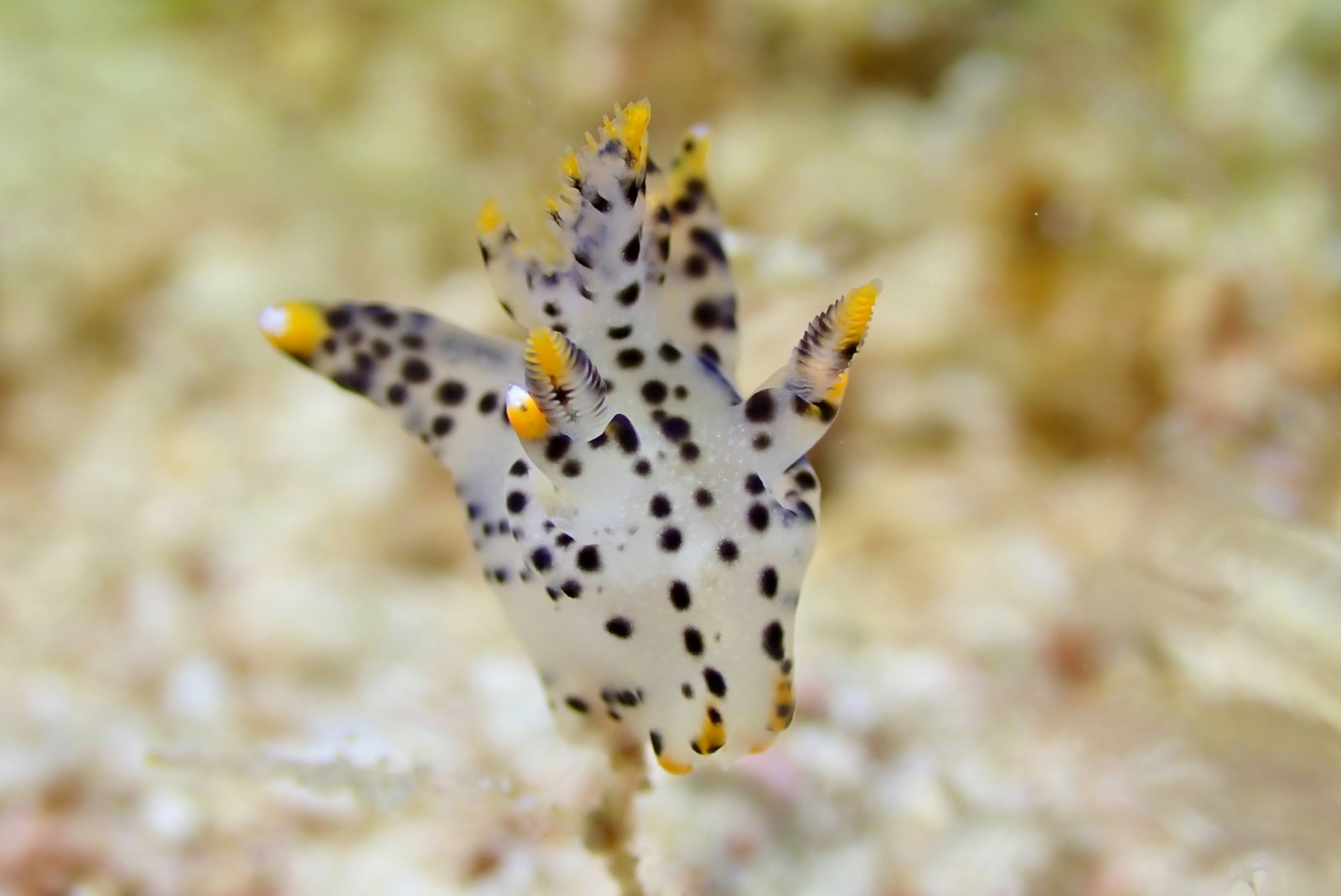
Arguably the most consistent draw. Chromodoris, Glossodoris, Phyllidiella and Flabellina species all turn up here regularly. The variety is not Lembeh-level — this is a national park reef system, not a purpose-built muck bay — but on a good dive you might log a dozen species in a single tank. The coral heads at mid-depth (10–14 m) are especially productive after a slow sweep.
Frogfish
Wainilu holds frogfish with unusual reliability. Warty frogfish in particular have been spotted on sponge heads and rubble piles repeatedly across different seasons. They do not move, which makes them a gift for macro photographers; finding them in the first place requires a guide who knows the site. This is not a place to free-roam — stay with your guide, and let them lead you to the specific coral heads and rubble patches they have been checking all season.
Pipefish and Ghost Pipefish
Both robust pipefish and the more elusive ghost pipefish (Solenostomus spp.) have been documented here. Ghost pipefish are masters of camouflage — they hover head-down near crinoids and feather stars, matching colour perfectly. Your guide will spot them; most divers swim within 30 cm and miss them entirely.
Seahorses
Thorny and common seahorses both occur at Wainilu, usually hitched to hydroids or coral rubble. Low ambient current is the reason — seahorses are poor swimmers and will not hold station on an exposed, high-energy reef. The sheltered character of this site is precisely what makes it viable habitat for them.
Octopus
Day octopus are active hunters at Wainilu and are regularly seen on daytime dives, flushing colour across their skin as they move between coral heads. At night, octopus activity increases noticeably; night divers often see two or three animals in a single dive.
Other Macro Life
Mantis shrimp, shrimp goby pairs, jawfish hovering at burrow entrances, ribbon eels (both black juvenile and blue adult males), and various flatworms round out a typical species list. The coral heads also support healthy populations of smaller reef fish — anthias, damsels, wrasse — which give photographers something to fill the frame when the macro hunting is quiet.
A Note on Mandarin Fish
Wainilu is often mentioned by divers in connection with mandarin fish. I want to be direct about this: our research has not confirmed mandarin fish as a reliably present species at this site, and I will not put it in the headline. If you have dived Wainilu and seen mandarins, I would genuinely like to hear about it via our enquiry form — but the site is worth every minute of your time for its verified critter density alone, without needing to be something it may not consistently be.
Wainilu vs Other Komodo Macro Sites
| Site | Depth | Current | Min. Cert | Macro highlight | Night dive? |
|---|---|---|---|---|---|
| Wainilu | 5–20 m | Low–negligible | Open Water | Frogfish, nudibranchs, seahorses, octopus | Yes — liveaboard only |
| Siaba Besar | 5–18 m | Calm | Open Water | Turtles (very high density), nudibranchs | Rarely scheduled |
| Siaba Kecil | 5–25 m | Mild–moderate | OW–intermediate | Turtles, stingrays, pipefish | Occasionally |
| Cannibal Rock (south) | 5–30 m | Mild–strong by tide | AOW recommended | Sea apples, rhinopias, pygmy seahorses — top-tier | Yes — liveaboard only |
| Pink Beach | 2–20 m | Mild | Open Water / snorkellers | Anemonefish, small reef life | No |
If your primary goal is macro photography and you are on an Open Water ticket, Wainilu is your site. If you hold AOW and have the stomach for colder water (20–25°C, 5–7 mm suit advised), the liveaboard extension south to Cannibal Rock in Horseshoe Bay offers a step up in raw macro biodiversity — it is frequently cited as a world top-10 macro dive. But it requires a multi-day liveaboard that reaches the southern park and it is not a beginner site by any measure. Wainilu gives you a genuine fraction of that experience at Open Water level, in warm water, from a day boat.
Night Diving at Wainilu
This is where Wainilu separates itself from most central-park dive sites. Night dives at Komodo are liveaboard-only — day trips return to Labuan Bajo before dark, and there is no practical way to do a scheduled night dive from the harbor on a day-trip boat. If Wainilu night diving is on your list, you need a liveaboard itinerary that includes it. Not all itineraries do; check before you book.
The profile at night stays deliberately shallow: 8–15 m, slow pace, torch beams sweeping across rubble and coral heads. The transformation the site undergoes after dark is real. Octopus that were tucked away during daylight hours come out to hunt actively. Sleeping parrotfish in their mucous cocoons hang motionless above coral. Nudibranchs, which are hard to spot against daytime visual noise, become unmissable under a torch. Crabs, shrimp and other invertebrates that spend the day hiding in crevices move freely across the substrate.
Night dives require a functioning primary torch and a backup, a surface marker buoy deployed on ascent, and ideally a small tank light or clip light so your buddy and the guide can track you at depth. Your operator will brief all of this before the dive. Do not skip the briefing — night diving in an unfamiliar location with an unfamiliar boat and guide has its own procedural discipline even when the currents are gentle.
For a full comparison of what you gain and give up with liveaboard versus day-trip diving — including which sites and dive types require a liveaboard — see our guide to day trips vs liveaboards.
Ready to put Wainilu on your Komodo itinerary? Plan your trip with our concierge — tell us your certification level and whether night diving is a priority, and we will match you with the right day-trip schedule or liveaboard route.
Getting to Wainilu: Day Trip or Liveaboard?
Wainilu is reachable on day trips from Labuan Bajo, typically scheduled as a contrast dive alongside higher-energy sites like Batu Bolong or Tatawa Besar. The typical day-trip rhythm: meet at the harbor around 06:30–07:30, depart by 08:00, complete two or three dives including Wainilu, have lunch on board, return to Labuan Bajo by 16:00–17:30. Central Komodo sites run about 1–1.5 hours by speedboat from the harbor.
Day-trip pricing for a 3-dive day currently runs roughly IDR 2.5–3.6 million per person before park fees (observed operator range; confirm current rates at booking). Park fees on top typically run IDR 300,000–400,000 per diver per day — the exact itemization varies by operator, so ask for a breakdown before you commit. Gear rental is usually included on day trips; nitrox may be available as an add-on or occasionally included depending on the operator.
On liveaboards, Wainilu appears on 4-day and longer itineraries, commonly on the final morning before the Komodo dragon trek at Loh Liang and the return sail to Labuan Bajo. The 6-day and 8–9 day routes that combine north Komodo with south Komodo or Sumbawa also include it, usually in a slot that allows a night dive the evening before.
Who Should Dive Wainilu?
The short answer: almost everyone. Open Water certification, no minimum logged-dive floor beyond basic comfort, warm water, negligible current, shallow maximum depth. This site has essentially no technical barriers. The only divers I would redirect away from Wainilu are those whose sole interest is big-animal pelagic action — if you have come to Komodo specifically for the grey reefs and dogtooth tuna of Castle Rock, Wainilu will feel like a different sport. For them, I would schedule a third dive at Tatawa Besar or Manta Point (Karang Makassar) instead and keep Wainilu for the photographers in the group.
Underwater photographers, regardless of experience level, should treat Wainilu as a must-dive. The site rewards patience and buoyancy control rather than drift skills or depth range. If you have a macro lens, a dedicated strobe, or even a decent compact camera, you will come back to the boat with a full card.
Mixed groups — some divers, some snorkellers — can use Wainilu’s shallow zone (2–5 m over the inner reef) for snorkelling while the divers work the deeper rubble. Visibility in the shallows is usually adequate, and the calm conditions mean snorkellers are not competing with surge. Confirm the snorkel option with your operator when booking; not all day boats include formal snorkelling stops at every site.
Practical Tips Before You Dive
Bring a pointer or a small torch even on daytime dives — your guide will use one to illuminate crevices where frogfish and ghost pipefish hide, and it helps you follow where they are pointing without disturbing the animals. A macro wet lens on a compact camera will transform your images. Move slowly. Once you have located a subject, pause, let the silt you disturbed settle, then approach. Rushing a ghost pipefish at Wainilu is how you get an empty frame.
Buoyancy precision matters here more than at most Komodo sites. The substrate is fragile, and a knee-plant on the rubble can disturb an entire microhabitat — and it will unsettle the sand visibility for the divers behind you. If your buoyancy control is not confident, consider a buoyancy tune-up at Siaba Besar before hitting Wainilu; the latter rewards divers who can hover neutrally at 50 cm off the bottom for extended periods.
Your operator will brief the lost-diver procedure before the dive. Even at a calm site like Wainilu, the protocol is the same: if you lose the group, search for approximately 10 seconds, then ascend safely, deploy your surface marker buoy, and drift until the boat picks you up. The calm conditions make this straightforward, but do not skip carrying your SMB because the site feels easy.
Frequently Asked Questions
Is Wainilu suitable for beginner divers?
Yes. Open Water certification is sufficient, and there is no minimum logged-dive count that operators commonly enforce here. Low current, shallow maximum depth (20 m), warm water and easy entry make it one of the most accessible sites in Komodo National Park. It is often used as a second or third dive on day trips precisely because it is forgiving and allows divers to wind down after a higher-energy site earlier in the day.
Can I do a night dive at Wainilu on a day trip from Labuan Bajo?
No. Night dives at Komodo are liveaboard-only — day-trip boats return to Labuan Bajo harbor before dark, and scheduled night diving at park sites is not part of any day-trip itinerary we are aware of. If a Wainilu night dive is a priority, you need a liveaboard that specifically includes it; not all itineraries schedule it, so confirm before booking. See our day trips vs liveaboards guide for a full breakdown.
What camera setup works best at Wainilu?
Macro is king. A compact camera with a dedicated macro wet-lens and a single strobe will serve you better than a wide-angle DSLR rig at this site. The subjects are small, patient, and close-range. If you are shooting a mirrorless or DSLR in an underwater housing, a 60 mm or 100 mm macro lens is the right choice. Wide-angle glass is largely wasted at Wainilu — visibility is moderate, there are no large-format subjects, and the main interest is in the detail of things at 5–30 cm range.
How does Wainilu compare to Cannibal Rock for macro diving?
Cannibal Rock in the southern park (Horseshoe Bay, south Rinca) is regularly listed among the world’s top macro sites — its density of sea apples, rhinopias, pygmy seahorses and unusual nudibranchs is exceptional. However, it is accessible only by liveaboard, involves colder water (20–25°C, expect thermoclines), is recommended for AOW divers due to variable current, and sits inside a south Komodo route that is itself weather-dependent. Wainilu is the warm-water, Open Water-accessible, day-trip-reachable macro option for the central park. They serve different diver profiles rather than competing directly.
What park fees apply at Wainilu, and are they included in the day-trip price?
Komodo National Park fees for foreign divers currently run roughly IDR 300,000–400,000 per diver per day (marine park entry plus diver surcharge plus harbor fee; some operators itemize an additional conservation fee). These are almost always quoted separately from the day-trip dive price, which typically runs IDR 2.5–3.6 million per person for a 3-dive day. Always ask your operator for an itemized breakdown before booking; the total varies by how each operator structures their packages. Contact us if you want current confirmed rates — we can connect you directly with operators via WhatsApp and help you compare what is actually included.