Cannibal Rock & Horseshoe Bay: World-Class Macro in South Rinca

Lukas Wajong
April 22, 2026
16 min read
Cannibal Rock Komodo diving refers to a single submerged pinnacle off the sandy slope of Horseshoe Bay — Loh Dasami — on the south coast of Rinca Island, one of the two main islands of Komodo National Park. The site dives from roughly 5m at the crest to 30m at the base, with the richest zone concentrated between 15m and 25m. It is frequently cited among the world’s top macro dive sites, and that framing is not marketing: experienced underwater photographers who have dived Lembeh Strait, Anilao, and Puerto Galera put Cannibal Rock in the same sentence. The reasons are specific and structural — not just a good reef, but a precise combination of current feeding, substrate variety, and cold productive upwelling that creates habitat density unlike anything in the north of the park.
I set the certification floors and safety briefings for this site. The access here is not straightforward. Horseshoe Bay is a liveaboard-only destination, the water runs 20–25°C with thermoclines that cut colder, and the four distinct sites in the bay — Cannibal Rock, Yellow Wall of Texas, Torpedo Point, and Three Sisters — each carry different current exposures and experience thresholds. What follows is the full picture.
What Makes Cannibal Rock Different
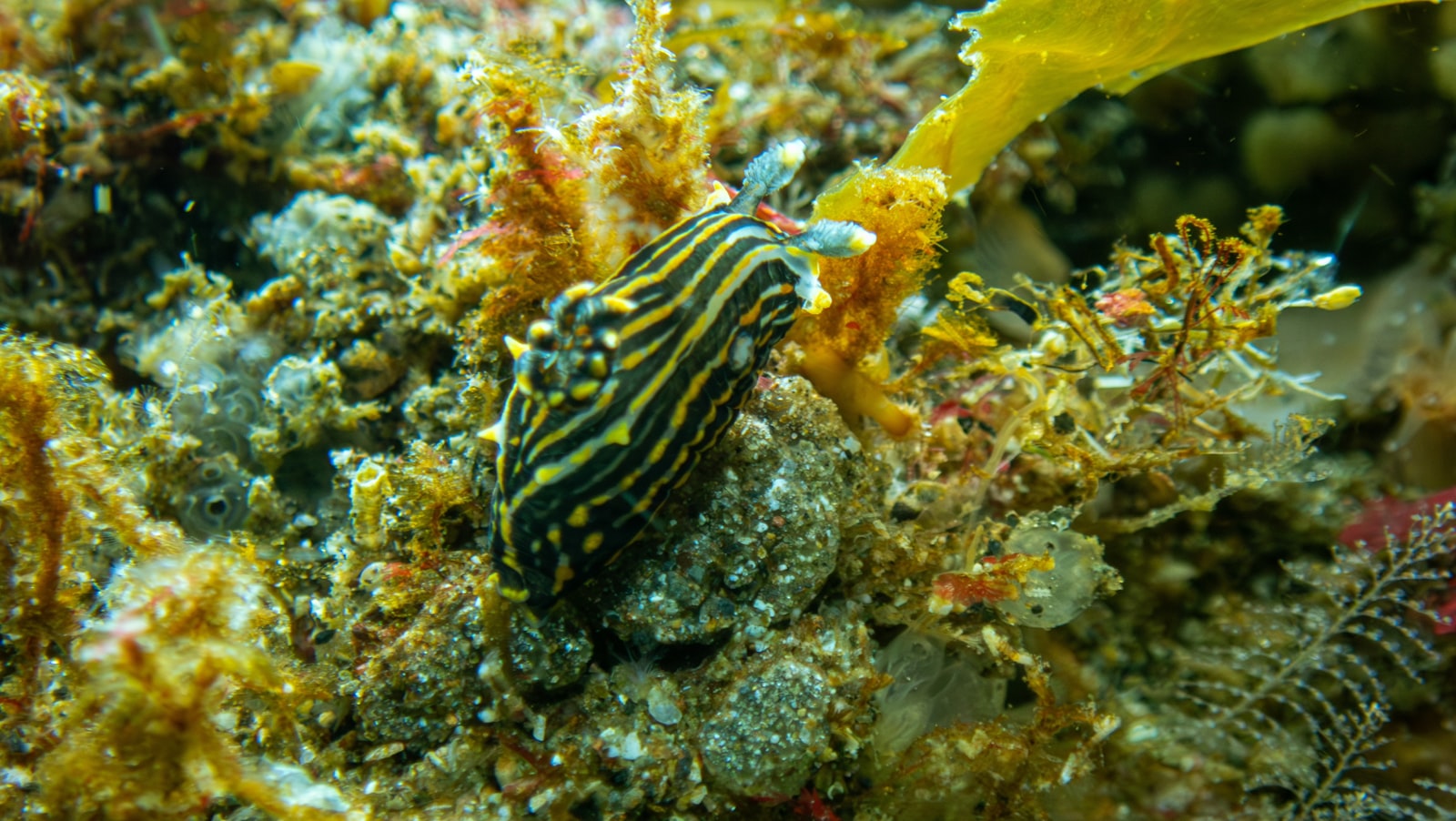
Most high-reputation dive sites earn their name from one standout species: the sharks at Castle Rock, the mantas at Manta Alley, the turtles at Siaba Besar. Cannibal Rock earns its reputation from accumulation. On a single 60-minute dive in the 15–25m zone, a typical species list might include: sea apples — the filter-feeding holothurians that are the visual signature of this site, blood-red and orange covered in white tube feet — alongside nudibranchs in double-digit species count, crinoids spanning every colour in the spectrum, colonial tunicates stacked in layers, frogfish in at least two or three colour morphs, leaf scorpionfish flattened against soft coral, rhinopias (the scorpionfish subfamily, rare enough that finding one anywhere else makes a trip), pygmy seahorses on gorgonian fans at mid-depth, zebra eels and ribbon eels in crevices, and Coleman shrimp living on fire urchins in the sand at the pinnacle base.
The list goes further than what fits on a dive slate. That density on one structure — not scattered across a dive trail, but concentrated on a single pinnacle — is what puts this site in a different category from most of Indonesia’s macro diving.
The ecological reason is straightforward once you understand the local hydrography. South Rinca sits in the path of cold, nutrient-rich Indian Ocean upwelling that pushes into the park from October through April. The pinnacle is positioned to intercept current from multiple directions as tidal flow moves across the bay. That current continuously feeds the filter feeders — the tunicates, the sea apples, the crinoids — which in turn support the predators and commensals that live among them. Cut off the upwelling and the site would be unremarkable. It is the cold, green water that makes it what it is.
This is also why Cannibal Rock is a seasonal site. Arriving in July or August expecting these conditions is the wrong move. During SE-monsoon months the Indian Ocean swell pushes into south Rinca, visibility drops, and the productive upwelling that sustains this ecosystem is disrupted. The south Komodo diving season — Horseshoe Bay included — runs approximately October/November through March/April, with December through February being the most reliable window.
The Dive: Depth, Profile, and What to Expect
The standard Cannibal Rock profile starts with a descent down the sandy slope adjacent to the pinnacle, typically reaching the base zone around 25–28m before working up the structure’s sheltered flanks. The richest photography zone is the mid-pinnacle band from 15m to 25m — this is where gorgonians carry pygmy seahorses, where rhinopias and leaf scorpionfish park themselves on soft coral outcroppings, and where sea apples cluster most densely.
The upper zone from 5m to 15m is less species-dense but still worth the safety stop: frogfish and nudibranchs are common here, and the hard coral coverage on the shallower sections of the pinnacle is intact enough to be worth the look. Most divers spend 50–65 minutes on Cannibal Rock with a competent guide; rushing through it misses most of what makes the site exceptional. The macro at this site is small. Pygmy seahorses measure under a centimetre. Coleman shrimp, rhinopias, and leaf scorpionfish are designed to disappear into their substrate. You will miss them without pointing direction from a guide who knows the site.
Currents run mild to strong depending on tidal state. On neap tides and around slack, conditions are gentle enough for Open Water divers with solid buoyancy. On spring tides or during mid-ebb, current can pick up significantly and require active finning or a sheltered-side approach. This variability is why Advanced Open Water is our recommended gate — not because the site is constantly challenging, but because you need current-reading skills to navigate the tidal windows safely and make the most of the dive.
Water Temperature and What to Wear
The honest number for water temperature at Cannibal Rock is 20–25°C, and within that band you should plan for the colder end rather than assume the warmer. Thermoclines are standard at depth — a 3–4°C drop somewhere between 15m and 22m is typical during peak upwelling months. On a dive that keeps you in the 20–25m zone for most of its duration, that matters.
A 5–7mm wetsuit with a hood is the practical requirement. I tell divers this directly in every pre-dive briefing and I mean it both ways: 5mm is the minimum a thin-blooded diver should consider, and 7mm is not an overreaction if you feel the cold. The photographers who get the best results at Cannibal Rock — the ones who can hold position on a pygmy seahorse for three minutes without drifting — are warm enough to focus. Divers who are fighting the cold spend their bottom time fighting the cold. Bring enough neoprene.
If you are coming from a day of diving at Manta Point or Tatawa Besar in the north, which runs 27–29°C, be ready to change your suit. Liveaboards on routes that cover both zones — which is any 6-day-or-longer itinerary — will typically anchor in south Rinca during the cooler part of the route. Factor that into your gear packing.
Horseshoe Bay: The Full Site Cluster
Cannibal Rock does not exist in isolation. The bay at Loh Dasami holds three other distinct sites, and a well-run south day typically includes two or three dives across the cluster. Understanding what each one offers is useful before the trip, not just on the briefing morning.
Yellow Wall of Texas
The Yellow Wall runs as a wall from about 5m to 30m, with the core section between 15m and 25m smothered in yellow soft corals and colonial tunicates — the colouration is consistent enough that on a clear-water day the wall registers as visually distinctive even from 10m away. The macro photography here is different from Cannibal Rock: fewer headline creatures, more systematic wall-reading. Ghost pipefish appear consistently — sometimes more than one species on a single dive. Orangutan crabs sit in crinoids at mid-depth. Flatworms cross the wall face in deliberate paths. Cowries and nudibranchs are constant. Moderate drift at times; AOW divers with wall experience will be comfortable here. It runs well as the second dive after Cannibal Rock when tidal state has shifted slightly.
Torpedo Point
Torpedo Point — south Rinca, not to be confused with any site at Manta Alley, a naming collision that causes genuine confusion — is a sloping rubble and sand site from about 10m to 25m. Low to moderate current at standard windows. The signature species is the torpedo ray (electric ray) resting in the sand: once you know the outline to look for — a disc-shaped depression with two small eyes — you start finding them regularly, sometimes multiple on a single dive. Alongside them: mimic octopus and wunderpus working the rubble margins, and frogfish in the substrate.
Torpedo Point is also a strong night dive. The electric rays become active after dark, octopus leave their holes, and the rubble that looks static in daylight becomes an active hunting ground. On liveaboard itineraries that anchor in Horseshoe Bay overnight, a Torpedo Point night dive is a realistic addition to the day’s schedule. Intermediate level — Open Water with 20+ logged dives and good buoyancy handles it fine in calm tidal conditions.
Three Sisters
Three Sisters is the high-energy site in the cluster — three submerged pinnacles with their tops at roughly 10–15m and bases at 30–35m. Exposed positions, eddies behind each pinnacle, down-current risk in the saddles between them. This is not a site for divers still developing current management skills. The reward — on a manageable neap-tide window — is gorgonian fans with pygmy seahorses, large anthias and fusilier schools riding the pinnacle crests, and reef sharks below in the current. Experienced AOW, 50+ logged dives. If conditions are questionable on the day, I will pull a group and redirect to Yellow Wall or run a second dive on Cannibal Rock. The site does not benefit from pressing it.
Dragons on the Beach
Horseshoe Bay sits on Rinca Island, the second major Komodo dragon habitat in the national park. Loh Dasami is adjacent to shoreline scrub and beach where dragons move regularly, and on liveaboards anchored in the bay overnight, sightings from the boat deck or during surface intervals near shore are genuinely common. These are wild animals in remote coastal habitat — not a trekking station — and the encounters tend to carry a different quality from a guided Komodo or Rinca land tour.
For groups where not everyone is diving, the Horseshoe Bay anchorage offers something above the water line that north-park stops generally do not. Worth factoring into mixed-group planning.
Visibility and Conditions: The Honest Version
South Rinca visibility during the October–April window runs typically 10–20m, with the potential to reach better in January and February when conditions are at their most settled. Green water from phytoplankton bloom is normal and expected — it is part of what makes this ecosystem productive. If you are coming from a background of tropical blue-water diving, calibrate accordingly: this is not 30m vis through clear Flores Sea water. The trade is that you are diving in one of the most biologically productive columns of water in Indonesia.
Worst-case visibility in marginal conditions can drop to 8–10m, which still supports a full Cannibal Rock dive because most of what you are looking at is within 1–3m of the structure anyway. Wide-angle shots of the whole pinnacle require better vis, which is another reason January–February is the preferred window for photographers.
Thinking through your timing and whether the October or November window works for your schedule? Plan your trip with us — we can tell you what conditions looked like in previous seasons and which boats run dedicated south-Komodo commitments rather than weather-permitting optionals.
Certification and Experience Requirements
- Cannibal Rock
- Advanced Open Water recommended; minimum AOW or Open Water with 30+ logged dives and demonstrably solid buoyancy control. Current variability requires active water-reading.
- Yellow Wall of Texas
- Advanced Open Water recommended; comfortable wall divers with drift experience.
- Torpedo Point (day dive)
- Open Water with 20+ logged dives, good buoyancy. Low to moderate current at standard windows.
- Torpedo Point (night dive)
- As above, plus night-diving experience and a primary torch. On most liveaboards, your first night dive will not be Torpedo Point.
- Three Sisters
- Experienced Advanced Open Water, 50+ logged dives, demonstrated current management. Not negotiable.
Horseshoe Bay is not the place for a diver who is still working out neutral buoyancy. The macro at Cannibal Rock and Yellow Wall exists in a fragile substrate — crinoids, tunicates, and gorgonians do not recover quickly from fin damage. Beyond reef conservation, the variable tidal currents here require enough water awareness to abort a descent to a sheltered position if conditions shift. I would rather move a group to Siaba Besar for a relaxed turtle dive than put an underprepared diver on the Cannibal Rock pinnacle during a spring-ebb push.
If you are Open Water certified and planning a liveaboard that includes south Komodo, completing your Advanced Open Water beforehand — or on the liveaboard itself, as many operators offer — is the sensible path. The south sites are accessible; they are just not accessible as a passenger experience.
Liveaboard Routes: How Cannibal Rock Fits the Itinerary
Horseshoe Bay is not reachable on a day trip from Labuan Bajo. The routing from the harbor to south Rinca covers roughly 60–80 kilometers of open water around the island; in transit time, that is three or more hours each way. The math does not work for a dive day. This is a liveaboard-only destination, and the minimum itinerary for a genuine south Komodo experience is five days — though six days gives you more margin to work the tidal windows and absorb a weather delay without sacrificing north-park sites.
| Duration | Horseshoe Bay Access | Typical South Dives | North Sites Included |
|---|---|---|---|
| 4D/3N | Rarely — central and north loop only | — | Castle Rock, Crystal Rock, Shotgun |
| 5D/4N | Often — 1 south day if weather permits | Cannibal Rock + Yellow Wall or Manta Alley | Partial north pass |
| 6D/5N | Standard — dedicated south day | Cannibal Rock, Yellow Wall, Torpedo Point, Manta Alley | Full north pass |
| 7–9D Komodo–Sumbawa | Yes — full south day plus Gili Banta, Sangeang | Full bay cluster + Torpedo Point night dive option | Full north pass |
On a 6D/5N itinerary — which is the standard full-park format — operators typically run the first dive day on sheltered central sites (Siaba Besar check dive, Mawan), move to Manta Point and Batu Bolong on day two, push south for day three to anchor in Horseshoe Bay, then work north for days four and five before an early morning dive and return transit on day six. The south day is often positioned mid-trip because you want settled, familiar divers on those sites, not day-one groups still calibrating buoyancy on a new boat.
On 6-day-and-longer routes, liveaboard pricing runs broadly from around USD 150–250 per person per night on budget operators, USD 300–500 on mid-range boats, and considerably higher on expedition-class vessels. Park fees — approximately IDR 300,000–400,000 per diver per day (around USD 18–27) — are quoted separately by most operators and are worth confirming before you book. For itinerary matching and current operator recommendations, see our liveaboard diving page; for the full south-zone seasonal context, the south Komodo diving guide covers the broader picture.
Nitrox at Cannibal Rock
Nitrox is worth serious consideration for Cannibal Rock. The most biologically interesting zone — 15–25m — puts you at a depth where air bottom times become a real constraint if you are trying to photograph slowly or hover on a single subject for an extended period. Nitrox on a 32% mix at 25m gives you a no-decompression limit of around 50 minutes versus around 32 minutes on air; at 20m, the gap is wider. For a site where the best practice is slow, patient observation rather than circuit swimming, that extra time is not trivial.
Most Komodo liveaboards carry nitrox — often included free on higher-end boats, an optional extra on mid-range. Confirm availability and cost before boarding if you are PADI Enriched Air certified and plan to use it. Day boats do not uniformly carry nitrox, but this is irrelevant to Cannibal Rock, which is not a day-trip site.
Frequently Asked Questions
What is Cannibal Rock, and why is it called that?
Cannibal Rock is a submerged pinnacle in Horseshoe Bay on south Rinca Island, Komodo National Park. It dives from 5m to 30m, with the richest macro zone at 15–25m. The name is believed to refer to the density of predatory species stacked in the water column — creatures eating each other at every level of the substrate. Whatever its origin, the name stuck and the site earned the reputation independently. It is frequently cited among the world’s top macro dive sites by experienced photographers who have dived comparable destinations globally.
Do I need Advanced Open Water to dive Cannibal Rock?
Advanced Open Water is strongly recommended. Currents at Cannibal Rock vary with the tide — mild on neap windows, strong on spring-ebb — and managing those shifts requires current-reading skills that the AOW curriculum specifically develops. A highly experienced Open Water diver with 30+ logged dives and solid buoyancy control can manage the site on calm tidal windows with a good guide, but AOW is the gate we apply because it is the safer standard for a site with variable conditions in a remote location with limited emergency access.
What is the water temperature at Cannibal Rock, and what wetsuit should I bring?
Water temperature in Horseshoe Bay runs 20–25°C during the October–April dive season, with thermoclines at depth taking you to the cooler end of that range or below. A 5mm wetsuit with a hood is the minimum; 7mm is appropriate for cold-sensitive divers and anyone who expects to do multiple dives per day in the bay. If your liveaboard also covers north-park sites at 27–29°C, you will need suit options for both thermal regimes.
When is the best season to dive Cannibal Rock?
October through April is the south Rinca season, with December through February being the most consistent window. Indian Ocean upwelling peaks in this period, visibility is at its best (typically 10–20m, with 20m+ possible in January–February), and biological productivity — which is what sustains the macro ecosystem at Cannibal Rock — is at its highest. Avoid July and August: SE-monsoon swell makes south Rinca rough and often undiveable at exposed sites, and the productive upwelling conditions that define this site are largely absent.
Can I reach Cannibal Rock on a day trip from Labuan Bajo?
No. Horseshoe Bay is approximately 60–80 kilometers from Labuan Bajo harbor by open water routing around Rinca Island — three or more hours of transit each way. A day trip would spend most of its hours moving, not diving. Cannibal Rock is a liveaboard-only destination; a 5-day itinerary is the practical minimum, and 6 days gives you a dedicated south day with enough margin to work tidal windows and absorb a weather delay.
Ready to plan a liveaboard that includes Horseshoe Bay? Use our enquiry form or message us on WhatsApp — we help match divers to itineraries based on certification level, travel dates, and what you actually want to dive, at no extra cost. If you proceed with one of our partner operators, they may pay us a referral fee; that does not change what we recommend.