Photographing Mantas at Karang Makassar: Position, Light & Patience
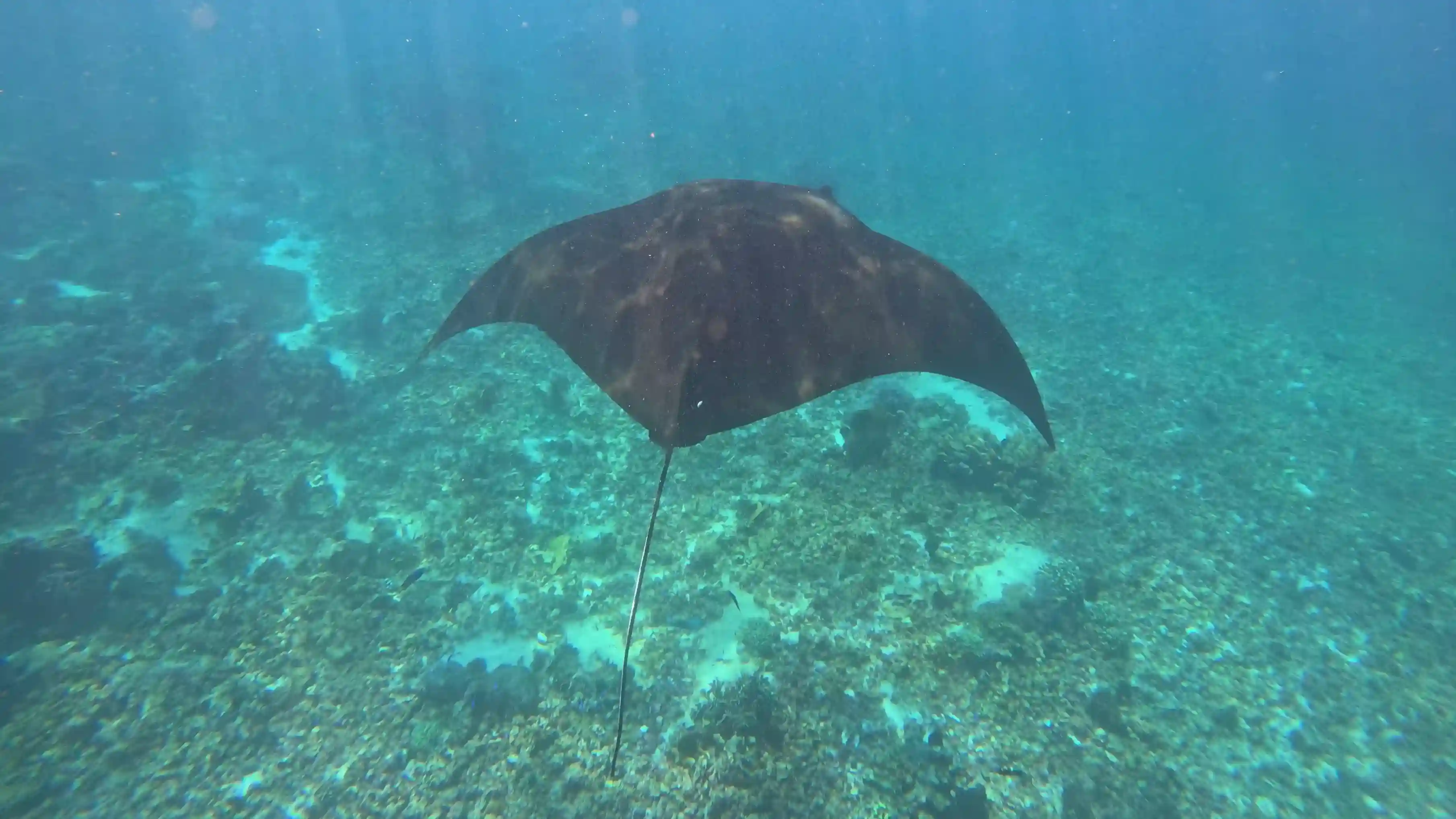
Photographing manta rays in Komodo comes down to three decisions: where you settle at the cleaning station, how you expose a white belly against blue water, and how long you are willing to wait without moving. Karang Makassar — the long central-Komodo drift most divers know as Manta Point — is the most reliable site in the park for reef manta (Mobula alfredi) encounters, and its 8–18 m working depth means most of the dive can be shot on ambient light alone.
The site rewards one discipline above all: pick a position, go still, and let the mantas run their own schedule.
Know the Site Before You Raise the Camera
Karang Makassar is a long, shallow rubble-and-sand reef with scattered coral bommies that function as cleaning stations, where mantas hover while cleaner wrasse work over their skin and gills. Typical depth is 8–18 m, and the current is usually a gentle to moderate drift — manageable enough that Open Water divers and even snorkellers can join.
For a photographer, that profile is a gift: the pale rubble bottom bounces light back up onto a manta’s underside, and the shallow depth strips far less colour from the water than a 25 m site would. If you have not dived it before, read our full Manta Point Karang Makassar site guide first — the drift line and bommie layout determine where your frames will come from.
Positioning: Work the Station Without Blocking the Lanes
Mantas approach a cleaning station on predictable lines — typically into the current, holding over the bommie, then peeling off and circling back. The biggest photographic mistake here is parking yourself in one of those lanes: block the approach and the manta aborts; block the exit and it stops circling.
Instead, settle low on bare rubble or sand — never on coral — a few metres to the side of the station and slightly down-current. Stay below the manta’s line of travel, keep your profile small, and breathe slowly; fast exhaust bubbles under a hovering manta will often push it off the station. In a group, spread out in an arc on one side rather than forming a wall around the bommie.
Then do the hard part: nothing. Uncrowded mantas settle into repeating circuits, and the third or fourth pass is almost always closer than the first. The photographers who leave with portfolio frames are rarely the ones who moved the most.
Natural Light vs Strobes: Exposing the White Belly
At 8–18 m, ambient light is a genuine option for most of the dive — especially above 12 m in the middle of the day. Natural light keeps your rig simple and avoids lighting up particles. The classic Karang Makassar frame — a manta gliding overhead, belly lit, wingtips spread against the surface — is usually best shot upward on ambient light.
The catch is the belly itself. A reef manta’s white ventral surface is the brightest thing in the frame, and it blows out easily. Expose for the belly, not the scene: dial in around a stop of negative compensation, accept a darker background, and lift the blue in post. Blown highlights also destroy the spot patterning used to identify individual mantas — detail you cannot recover.
If you bring strobes, treat them as fill, not the main light. Run them at low power, pulled wide and angled slightly outward so only the edge of the beam catches the animal — this dramatically reduces backscatter in plankton-loaded water. Full-power strobes at close range on a white belly produce exactly one result: a glowing, detail-free triangle in the middle of your frame.
The Plankton Trade-Off: More Mantas, Softer Water
There is an honest trade at this site. Central Komodo visibility typically runs 15–25 m, but it can drop noticeably during plankton-rich periods — and those plankton pulses are precisely what draw feeding mantas in numbers. The most manta-active days are often the greenest, most particle-filled ones.
The broad diving window helps you plan around it: April–November is the prime dry-season stretch, with April–June and September–November offering the best mix of calm seas and visibility, while December–March is wetter but central sites are still dived and crowds thin out. Our Komodo manta season guide breaks the calendar down month by month.
Photographically, do not fight soft water. Get closer — cut the water column between you and the subject to a minimum, which is another argument for letting mantas come to you. Shoot wide, keep strobes off or feathered, and lean into the atmosphere: a barrel-rolling manta feeding through a visible plankton cloud tells a truer story of this site than a sterile blue-water frame.
The Black Manta Opportunity
Karang Makassar also offers one of the most striking subjects in Indonesian waters: the melanistic, or black, morph of the reef manta, which carries dark pigment across most of its body, often with only a small pale patch on the belly.
Everything about your exposure logic inverts. Where a normal manta threatens blown highlights, a black manta threatens a detail-free shadow — so open up, watch the histogram’s left edge, and protect the subtle tonal separation along the wings. The site helps you here: against the pale rubble bottom, a black manta shot slightly from above becomes a high-contrast graphic shape that needs almost no post-processing. Treat any black manta as a bonus — sightings are never guaranteed — but be ready to swing your compensation the moment one enters the circuit.
Etiquette That Buys You More Frames
Manta etiquette here is not conservation box-ticking — it is the highest-leverage photographic technique available. Indonesia declared its entire exclusive economic zone a manta ray sanctuary in 2014, and park-level interaction rules continue to evolve, which we track in our Komodo manta tourism regulations overview.
The behavioural rules are simple: never chase, never touch, never block, never hover directly above a cleaning manta. The payoff is equally simple: an unpressured manta stays on station longer, circles more, and comes closer with each pass — more frames, better angles, closer passes. One diver chasing a manta off the bommie ends the shoot for the whole group. Patience is not the polite option here; it is the productive one.
Fitting Photography Into a Normal Dive Schedule
You do not need a dedicated setup to shoot mantas here. On scheduled Komodo fun diving trips, Karang Makassar is a staple of the central-park circuit at every level. For photographers who want repetition — the same station in different light, tide, and plankton conditions — multi-day Komodo diving packages that revisit the site are a more reliable route to a keeper frame than any single lucky drift.
Boats across the cluster run through Komodo Luxury’s diving programme, from day boats to liveaboards, so the same standards apply whether you shoot the site once or five times in a week.
Frequently Asked Questions
Do I need strobes to photograph mantas at Karang Makassar?
No. At 8–18 m the site is shallow enough for ambient-light shooting through most of the dive, particularly above 12 m around midday. Strobes help as low-power fill for close passes, but in plankton-rich water they often create more backscatter than they are worth.
What certification level do I need to dive Manta Point?
The gentle to moderate drift makes Karang Makassar accessible to Open Water divers, and snorkellers can often join the same trips. For photography, buoyancy control matters more than certification level — you need to hold a low, still position on rubble without touching coral.
When is the best time to photograph mantas in Komodo?
The diving window runs April–November, with April–June and September–November offering the best balance of sea state and visibility. Manta activity often peaks with plankton pulses that reduce visibility, so the best photography days balance manta numbers against water clarity.
Are black manta sightings guaranteed?
No. Melanistic reef mantas do appear at Karang Makassar, but no operator can promise a sighting on any given dive. Diving the site across multiple days meaningfully improves your odds.
Why does dive pacing matter so much for photography here?
Because encounter quality depends on mantas settling into repeat circuits, which takes time. A hurried drift produces distant, single-pass frames; a schedule built around waiting at active stations produces close, repeated passes.
Shoot It Properly: Book a Photography-Paced Charter
Of everything above, pacing makes the biggest difference at this site — and it is the factor a photographer controls least on a standard schedule. A dedicated Komodo underwater photography dive charter is built around exactly that: small groups, briefings mapped to the actual station layout, entries timed to tide and light, and the freedom to stay with an active bommie until the mantas settle instead of moving on at minute forty.
Tell us what you shoot and when you are travelling, and we will build the schedule around your camera. Message us on WhatsApp at +62 811 3823 875 or email bd@juaraholding.com to plan your Karang Makassar photography days.